
Displaying items by tag: Tova Wolff
Standing Room Only Crowd for Chicago’s Leading Theater Artistic Directors
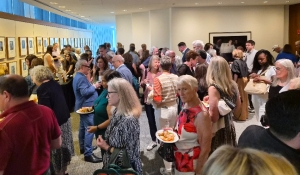
It must have been heavenly for the creative leaders of Goodman, Steppenwolf, Chicago Shakespeare and Court, Chicago’s top regional theaters, to be greeted by a standing room only crowd. But there they were, on a panel moderated by the eminent Chicago Tribune theater critic Chris Jones. The program was introduced by Marla Mendelson, MD, then by her daughter, Tova Wolff, who also happens to be artistic director at Refracted Theatre Company.
Held on the 6th floor of the airy University of Chicago Gleacher Center overlooking the Columbus Drive bridge at the Chicago River, the event was part of the Evening Inquiry Series founded by Mendelson and her husband Stephen Wolff, and arriving on the heels of a landmark report from the Arts Alliance Illinois that shows the creative sector is the sixth largest business sector in the state. In Chicago, where nearly half (47.5%) of the overall state’s direct creative economy output takes place, the sector supports 212,875 jobs, generates $50 billion in output, and generates $5.7 billion in tax revenue. It is Chicago’s 3rd largest industry (11.3%), larger than educational services (10.2%), retail (8.3%), and manufacturing (7.9%).
Citing that as a backdrop, moderator Chris Jones led the panelists through the discussion.
Also referencing the report, Edward Hall, artistic director at Chicago Shakespeare Theater noted, “This city has a very powerful, strong cultural economy as well, which I think feeds social and cultural life, but also it's an economic driver. And you haven't even begun to count the trickle-down effect of people's secondary spending when they fly into town and see Iceboy, or they see Lord of the Rings, whatever they come and see. They're taking cabs. They're going to hotels. They're spending money.”
Jones's questions led to the perhaps surprising revelation: subscriptions to theaters have dwindled. Audrey Francis, artistic director for Steppenwolf, said that at its height, Steppenwolf had 25,000 season subscription holders. “And now we have 5,000,” she said, which was the number when she started her tenure at the theater.
“It's challenged me as an artist to say, ‘Okay, this is the game,’” said Francis. “And it's not about, for us, necessarily what's popular. It's about how are we being our best to make sure that when you come dance with us, we're the best dance partner you have.” According to Francis, “Being challenged to evolve and to keep up and to say, ‘Okay, we can't keep doing the same thing. The rules are changing, and everybody's getting better, and how do we keep up?’”
Budget-wise, ticket revenue overall covers just half the operations of any of these theaters.What that means for theater operators is audience preferences and marketability to individual ticket buyers is a key driving force in the creative selection of scripts to be produced at larger Chicago theaters. Given that, how do artistic directors determine the roster of shows for each season?
What came up in the course of the panel is that there is serious tension (as might be expected) between including the established “canon” of playwrights—Eugene O’Neil, Ibsen, Chekov, Shakespeare, Shaw, etc.—and new works from rising talents around the country. Over recent years new works have risen in prominence, while the number of scripts from the old guard have diminished.
The event was preceded with an open bar reception and generous array of hor d'oeuvres, during which the audience mingled. There were actors, creatives from theater companies, and the regulars who attend these Evening Inquiries sessions at the University of Chicago’s Gleacher Center. As a theater critic for Buzz Center Stage, I recognized a number of publicists from theatrical groups and agencies that specialize in communications for this marketplace.
One woman I spoke to was the spouse of an actor. I also met a man who was a retired professor of drama from Bates College in Lewiston, ME, who complained heartily of the numerous new works in seasons just announced by the panelists’ theaters, to the exclusion of Shaw and other traditional canonical works. “What’s the best thing you’ve seen in the last year?” he asked me, his voice ripe with challenge. I answered unequivocally: “The Devil Comes to Town at Trap Door Theater.” (It was adapted and directed by Jeremy Ohringer who is also on the faculty at DePaul University.)
This was a perfect lead-in to the discussion of seasons filled with newer works, discovered through careful dramaturgy of who and what is trending around the country, which may be unfamiliar to Chicago audiences. There is risk attached to trying such unknown works as part of a mission for exposing audiences to what the theaters think they might or should like.
“If you go back to that origin statement about serious, mission-driven work, fully fifty percent of your annual income is box office dependent,” said Susan Booth, artistic director at Goodman Theatre. Producers can no longer rely on subscription ticket holders to weather through whatever they’re given in a season. “That box office number is a reality in our day-to-day life,” Booth said. “And I would love to hear from my colleagues on the panel about the challenge of selling mission-driven work versus selling popular work.”
Chicago Shakespeare’s Hall noted that theater lives in a perpetual recession. “There has never been a moment when I've heard any of my colleagues say, ‘What do we do with all this excess money?’ And theater has always been striving to do mission-driven work. And the idea that if you go popular, it's easy,” Hall said, “it's a lie, actually.” (Though the exception proving the rule perhaps are the lavish productions at Paramount Theatre in Aurora, generously underwritten by its neighboring casino profits.)
Avery Hoffman, who was named artistic director just last November at Court Theatre at the University of Chicago, described her theater’s audiences as many layered: the students and faculty on campus, individuals throughout the surrounding Hyde Park area, and the entire south side of Chicago, the city at large and the region. “This knowledge of your audiences is really, really important to that collective thinking, certainly to my collective thinking,” Hoffman said. “It means that our seasons maybe take a little bit longer to come to fruition. But then at the end of the day, you have a collective agreement about what your mission is, what shows that you're doing that serve that mission, and an audience that knows that mission and is there to support [it].”
A lengthy discussion covered the shifting role of these big regional theater companies from gatekeepers of what should be seen by audiences, to collaborative facilitators of what audiences want—even if that means bringing them unfamiliar scripts that meet their latent interests. Francis noted that the ensemble-powered company of Steppenwolf has long meant that the establishment of each season's offerings is the product of intense creative conflict, in the best sense of those words.
Best Question of the Night
After 30 minutes, Jones entertained a few questions from the audience, and the first out-of-the-gate came from a long-haired young man who cited the recent transfer of the a cappella musical Octet from Raven Theatre’s space on Clark St. to extend its run at the Goodman’s Owen Theater for three weeks this summer.
Goodman’s Booth responded that she had an immediate reaction when she saw Octet at Raven: “I thought the ceilings are just too low for these great voices.” And so it happened, but that is a rarity in Chicago. “The big theaters are often dark,” the questioner pointed out, and these successful storefront shows need to be able to get to bigger venues in order to extend their runs, rather than simply close to accommodate a subsequent planned production from their own season. "All of us are keenly aware that we benefit from the ecosystem," Booth said, referring to Chicago's many storefront and small theaters.
Of course, this is the natural ecosystem in New York, where Off Off Broadway shows frequently transfer to Off Broadway and sometimes on to Broadway—usually driven by proven audience demand. Why couldn’t that happen more frequently in Chicago? This led to an intriguing proposition from Chicago Shakespeare's Hall for a separate non-profit theatrical entity that might serve as a development center for co-producing shows, lef by Chicago's regional theaters.
Three cheers to University of Chicago and Mendelson's Evening Inquiry series for putting this remarkable discussion of theater on stage.




Latest Articles
-
 Standing Room Only Crowd for Chicago’s Leading Theater Artistic Directors
Written by Bill EslerIt must have been heavenly for the creative leaders of Goodman, Steppenwolf, Chicago Shakespeare and Court, Chicago’s top regional theaters, to be greeted by a standing room only crowd. But there they were, on a panel moderated by the eminent…
Standing Room Only Crowd for Chicago’s Leading Theater Artistic Directors
Written by Bill EslerIt must have been heavenly for the creative leaders of Goodman, Steppenwolf, Chicago Shakespeare and Court, Chicago’s top regional theaters, to be greeted by a standing room only crowd. But there they were, on a panel moderated by the eminent… -
 The Best of Us: Marriott Theatre’s Come From Away
Written by Kimberly KatzCome From Away begins from a place of deep uncertainty, yet what emerges is a story grounded in the steady, everyday kindness people offer when they have nothing else to give. Rather than revisiting the events of September 11 themselves,…
The Best of Us: Marriott Theatre’s Come From Away
Written by Kimberly KatzCome From Away begins from a place of deep uncertainty, yet what emerges is a story grounded in the steady, everyday kindness people offer when they have nothing else to give. Rather than revisiting the events of September 11 themselves,… -
 Steppenwolf Theatre Presents Revival of TOPDOG/UNDERDOG September 17 – November 1 / Rehearsals Underway
Written by Buzz Center StageSteppenwolf Theatre Company, the nation's premier ensemble theater company, is pleased to launch its 51st Season with Suzan-Lori Parks' Pulitzer Prize-winning drama Topdog/Underdog, helmed by Tony Award-winning director Kenny Leon, who returns to Steppenwolf following his hit production of King James. Ensemble members Glenn Davis (Windfall, Purpose–Chicago/Broadway, King James) and Namir Smallwood (Windfall, The Book of…
Steppenwolf Theatre Presents Revival of TOPDOG/UNDERDOG September 17 – November 1 / Rehearsals Underway
Written by Buzz Center StageSteppenwolf Theatre Company, the nation's premier ensemble theater company, is pleased to launch its 51st Season with Suzan-Lori Parks' Pulitzer Prize-winning drama Topdog/Underdog, helmed by Tony Award-winning director Kenny Leon, who returns to Steppenwolf following his hit production of King James. Ensemble members Glenn Davis (Windfall, Purpose–Chicago/Broadway, King James) and Namir Smallwood (Windfall, The Book of… -
 Chicago Black Dance Legacy Project Gala: Radiant & Sumptuous at the Harris
Written by Mitchell OldhamThe first thing you notice about the meticulously curated Black dance performance held at the Harris Theater over the weekend is language. The eloquence and weight of the words used to explain why the Chicago Black Dance Legacy Project (CBDLP)…
Chicago Black Dance Legacy Project Gala: Radiant & Sumptuous at the Harris
Written by Mitchell OldhamThe first thing you notice about the meticulously curated Black dance performance held at the Harris Theater over the weekend is language. The eloquence and weight of the words used to explain why the Chicago Black Dance Legacy Project (CBDLP)…
Does your theatre company want to connect with Buzz Center Stage or would you like to reach out and say "hello"? Message us through facebook or shoot us an email at This email address is being protected from spambots. You need JavaScript enabled to view it..
*This disclaimer informs readers that the views, thoughts, and opinions expressed in the text belong solely to the author, and not necessarily to Buzz Center Stage. Buzz Center Stage is a non-profit, volunteer-based platform that enables, and encourages, staff members to post their own honest thoughts on a particular production.