
Displaying items by tag: Elliot Esquivel
Pure Vocal Magic: Goodman’s Octet Redefines Musical Innovation
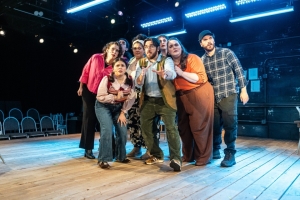
Dave Malloy’s Octet is a musical with daring aspirations, currently gracing the stage in a powerhouse co-production between the Raven Theatre and the Goodman Theatre. This staging, directed by Keira Fromm, first debuted at the intimate Raven Theatre, where it enjoyed a highly successful run before its move to the Goodman - a transition that proves the project is as robust as it is ambitious. Octet stands apart as a completely a cappella experience, relying entirely on the human voice to build its intricate, immersive, and haunting soundscape.
Malloy’s imprint is everywhere in this piece. He wrote the music, lyrics, book, and even the intricate vocal arrangements, crafting a score constructed without a single instrument to generate its tension, beauty, and emotional architecture.
Set in a sparse, church-basement style meeting room, the play introduces us to the “Friends of Saul,” a support group for people struggling with internet addiction. Their relationship to the online world is so fraught that they refuse to say its name, calling it only “the monster” to avoid giving it more power. Throughout their time together, the eight participants take turns sharing fears of being canceled, pornography, gaming, the pull of incel communities, and the inability to connect with others. Their discussions are brutally honest, darkly comedic, laced with expletives, and at one point offer an especially disturbing illustration of just how grotesque the monster can be. It’s unlike anything before.
The show threads each character’s intimate, emotionally charged account into sweeping ensemble passages that rise like contemporary hymns, the group joining voices to confront and grieve the “monster” that binds them. The interplay creates a pulse that feels communal and ritualistic, as though every personal admission is carried forward and reshaped by the collective.
The performances are nothing short of a whirlwind. The talent onstage is beyond belief. The ensemble showcases astonishing vocal mastery, blending with precision to create rich, enveloping music.
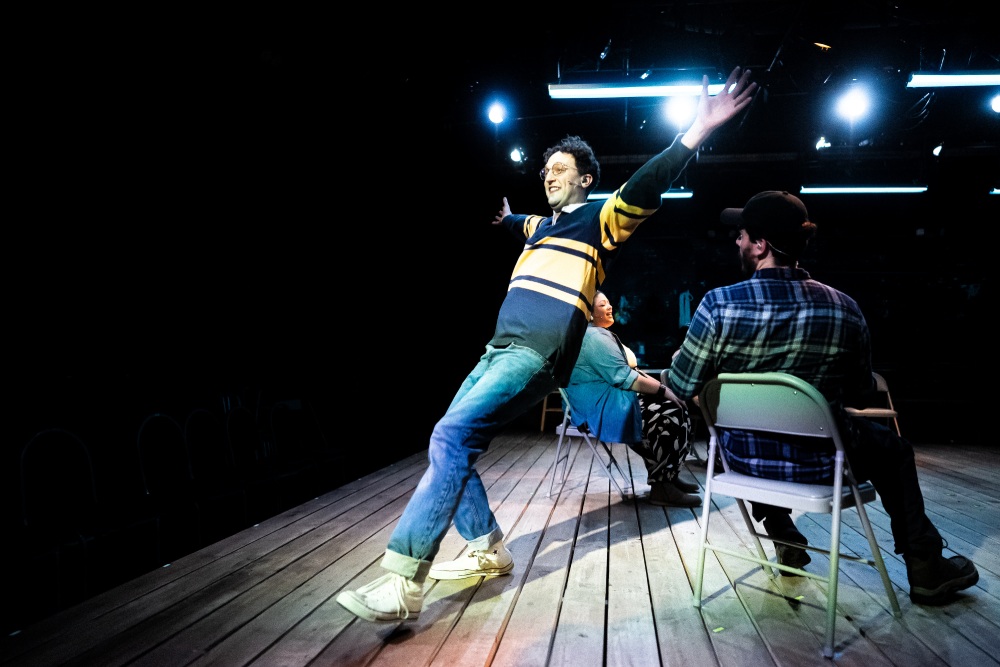
Sam Shankman in Dave Malloy's Octet at Goodman THeatre in collaboration with Raven Theatre. Photo by Joe Mazza.
Neala Barron, as Jessica, is phenomenal with powerhouse vocals and a dynamic stage presence. Her rendition of “Refresh” is delivered with the intensity of a tiger trapped in a cage, perfectly capturing the visceral feeling of being humiliated online and the subsequent rage against the world. Along with dramatic chops, she makes her comedic lines sizzle.
Sam Shankman plays the comedy perfectly as Henry. His portrayal of a tone-deaf, slightly dorky addict is both identifiable and deeply empathetic. His song “Candy” is a standout that demonstrates how this ensemble can craft story using only a cappella sound and how their movement reinforces the narrative.
Teressa La Gamba, as Paula, the group’s moderator, brings a gentle strength and compassion that helps root the show. But when she sings, it feels as if the roof will fly off. She commands the stage with perfect vocal precision, whether in a solo or complex ensemble passages.
The set is intentionally sparse and open, which functions perfectly for the show’s focused format, a choice scenic designer Milo Bue shapes with thoughtful restraint. The lighting design, crafted by Maximo Grano de Oro, is similarly impressive. Overhead lights shift deftly from the feel of a bland meeting room to the vibrant, chaotic interior of a Candy Crush interface or the dark corners of a character’s mind. In an instant, you can be transported to an entirely different plane and lost in its overwhelming atmosphere.
As the plot unravels, the staging seems intent on exploring where hope can or cannot be found, and it makes clear that faith-based religion is not where it looks. The script often approaches Christian belief with a skeptical edge, sketching certain “believer” archetypes in broad, unflattering strokes. The structure of “Friends of Saul” reinforces this orientation, lightly echoing the format of Alcoholics Anonymous. AA, one of the most widely recognized recovery communities, is often described as spiritual in nature, while many participants experience it as rooted in a faith-guided model, as it was originally intended. “Friends of Saul,” by contrast, operates with a more nonreligious bent, occasionally running out of pamphlets for “Steps for Agnostics and Atheists,” a detail made all the more ironic given that their meetings take place in a church basement - a space that pointedly distances itself from the faith‑oriented tradition AA is often associated with.
That contrast deepens in “Little God,” one of the staging’s more unusual songs. Here, Marvin (Jordan Golding), a committed atheist, describes an encounter with an all-powerful being represented onstage by a small girl and reflects on his compulsion to debate creationists about evolution. The moment is very much Malloy’s choice, framing Marvin’s fixation as a kind of intellectual loop: the irresistible pull of trying to reason through the idea that something as vast as existence might emerge from nothing at all, a purposeful artistic angle that shapes the show’s worldview.
Given these choices, the staging’s perspective may not resonate as strongly with audiences who hold traditional Christian views, which seems intentional, reflecting a deliberate direction in Malloy’s overall vision. In contrast, the show places greater emphasis on new age spirituality and tarot, treating these elements with notable sincerity. Each character has direct parallels to tarot cards, and Velma (Joryhebel Ginorio) finds her spiritual awakening through them. In fact, she is the only member of the group who speaks the monster’s true name, “internet,” throughout the night. Ultimately, the musical suggests that a blend of new age spirituality and human connection is the most viable path to inner peace.
Although these elements may pose challenges for certain audiences, Octet remains a triumph of vocal performance. These actors represent the highest caliber of Chicago talent, and when their voices come together, the result is breathtaking and inspiring. If you are looking for choral artistry, Octet delivers. For some audiences, Octet’s philosophical stance may feel more contemplative than corrective, raising more questions than answers about our relationship to the online world - but its musical brilliance makes the journey more than worthwhile.
Recommended.
Venue: The Goodman Theatre – The Owen 170 N. Dearborn Street, Chicago
Run Dates: Through August 2
Performance Schedule:
- Wednesdays: 7:30 p.m.
- Thursdays: 2:00 p.m. & 7:30 p.m. (No evening performance on July 30)
- Fridays: 7:30 p.m.
- Saturdays: 1:00 p.m. & 7:30 p.m.
- Sundays: 2:00 p.m. (Additional 7:30 p.m. performance on August 2)
Running Time: 1 hour, 35 minutes (no intermission)
Box Office: 312-443-3800
Tickets: https://www.goodmantheatre.org
In Lookingglass' White Rooster, Yee Conjures an Intriguing World Where Old and New Collide

White Rooster arrives at Lookingglass Theatre with the kind of wild, genre‑bending confidence that reminds you why this ensemble has always been one of Chicago’s most inventive storytellers. Ensemble member Matthew C. Yee - doubling as writer and director - conjures a darkly funny, legend-steeped ghost story that feels mischievously modern in this world‑premiere production. What begins as a family tale rooted in early‑1900s China unfurls into a surreal, music‑laced journey through a spirit-ridden American town of gold prospectors, where the living and the dead negotiate unfinished business with equal parts tenderness and absurdity.
That sense of slipping between worlds is echoed the moment you enter the space. For two gripping hours, the audience is submerged into a mysterious, rickety mining town - red light seeping through the floorboards as white, flowing curtains above and below the attic sensually breathe with every spectral draft. A mine entrance sits just below the stage; a shadowy passage characters slip into when needed to dig deeply for gold - and climb back out only if they are fortunate.
The theatre is arranged in a bold, innovative configuration that feels unmistakably Lookingglass, and once the lights go down, our surroundings tilt sideways. White Rooster summons a realm of folklore and restless spirits in a spellbound theatrical storm. There isn’t a bad seat in the intimate Lookingglass house.
Yee’s setting brilliantly blends Chinese mythology with timeworn Americana, woven together through Lookingglass’ trademark physicality and vivid visual artistry. Lookingglass builds a set that’s equal parts dusty ghost town and drifting dreamscape, all weathered wood, shifting platforms, and shadow‑hungry corners. Nothing stays still for long. Cloth walls slide softly across the room, lighting tricks the eye into seeing motion, and the entire environment reacts to the characters’ emotional temperature - as if the town itself is leaning in to listen.
The tone in White Rooster swings delightfully between eerie and, at times, hilarious – a fiancé who won’t stay dead, a sister who won’t stay buried, and a rooster whose presence is as oddly ominous as it is absurd. The stage is set for a journey that feels truly singular, a ride unlike anything else audiences will encounter.

Karen Aldridge in Lookingglass' White Rooster. Photo by Justin Barbin.
The story centers on Min (finely played by Sunnie Eraso), a young woman desperate to outrun her past, only to discover that the past travels fast - especially when it’s carrying old curses, stubborn spirits, and grief that refuses to stay buried. As the spirit world starts calling to her, we’re left wondering whether she’ll remain among the living or cross over to the dead.
Min stands at the center of White Rooster like a live wire - restless and, at the same time, determined. I feel that through her, the story becomes something of a tug‑of‑war between who we were raised to be and who we’re trying desperately to become. And every time Min thinks she’s found solid ground, the environment around her shifts - sometimes literally - reminding her that souls from the past don’t just haunt; they negotiate, bargain, and occasionally throw a tantrum in grand fashion.
Maria (fiercely played by Karen Aldridge) and John (vibrantly inhabited by Mark Montgomery) are Min’s parents and June (Noelle Oh – bravo!) her sister. Together they orbit Min with the gravitational pull of family - comforting one moment, complicating everything the next. Maria brings the ancestral weight, the traditions and expectations that shape the supernatural rules of this world – and she can tell a mean ghost story.
Reilly Oh is outstanding as Pong, a mythic wildcard who brings humor, mystery, and a touch of the uncanny. Pong is the character who reminds you that in this universe, what lies beyond the veil isn’t just a threat - it’s a personality, a mood, a powerful force with its own agenda. He and Min develop real, and complicated, feelings for each other, until an unexpected twist shifts the story’s course and ushers the white rooster into a central role.
Through it all, Pong’s parents Judy (Louise Lamson) and Hao (Daniel Lee Smith) are a strong support system for both Min and their son. Their performances, full of humor and tenderness, add texture and tension - the sort of familial presence that renders grief both intimate and unwieldy. In the meantime, June, Min’s ethereal sister residing in the attic, expands the emotional landscape. She gives Min someone who reflects the stakes of staying connected even when everything inside her screams to run. Together, they form a constellation of women whose histories overlap, collide, and echo through the dust of this otherworldly settlement. And in a twist that complicates everything, June’s heart belongs to the version of Pong that no longer exists. Blink and you’ll miss something; the play keeps unfolding in unexpected ways.
Fang, a medicine man and Wu are played by Elliot Esquivel through April 5th and Nik Kmiecik April 8th-26th. The two slip between identities with the fluidity of spirits who’ve long stopped caring about the boundary between the living and the dead. They capture the play’s obsession with inheritance - what we cling to, what we hide away, and what keeps clawing back to the surface no matter how deeply it’s buried. In the process, Esquivel scores a generous share of genuine laugh‑out‑loud moments.
Together, this ensemble of characters creates an atmosphere that’s sinister, hilarious, and deeply human, the kind of emotional tapestry that Lookingglass loves to unravel right in front of you. Though Yee’s approach is thematic rather than didactic, he offers no crystal‑clear moral - instead, June, Min’s spectral sister, delivers the closest thing to one: a deep, aching hunger for something she can’t find, especially heard in the way she screams “I’m hungry! I’m hungry!” It’s a hunger shared by every ghost drifting through this world or the next.

(from left) Noelle Oh, Reilly Oh, Sunnie Eraso in White Rooster at Lookingglass Theatre. Photo by Juston Barbin.
Ghost stories flare to life throughout the play by various characters - crisp, vivid, and wickedly staged - sending me right back to those childhood nights when one good scare made you latch onto the nearest friend. And, like a haunted house, the set and effects amplify it all, bringing this shadow-touched world to life with real ingenuity. Layered with White Rooster’s puppetry, which moves like a shared heartbeat - one force sculpting the landscape, the other lending its phantoms their physical form - the result feels kinetic in the eeriest way.
Yes, the puppetry slips right into this dimension, never as a gimmick but as the show’s beating heart of paranormal logic. From shadow‑puppeted silhouettes rippling across illuminated draperies to Dave and his scene‑stealing pet pig to the white rooster that becomes its own mythic force, the blend of object manipulation and visual animation is an imaginative jolt that feels handcrafted and otherworldly at the same time. Together, the set and puppets create a realm that feels porous and alive, the kind of roguish, immersive ecosystem where even the furniture seems menacingly capable of waking up.
This haunted domain comes to life through the combined minds of Natsu Onoda Power (scenery), Mara Blumenfeld (costumes), Hannah Wien (lighting), Justin Cavazos (sound and score), Amanda Herrmann (props), and Caitlin McLeod (puppets). Their contributions braid together - darkness blooming, objects murmuring, fabrics holding memory - until the world feels less crafted than conjured. The result is a creation that’s tactile, mischievous and emotionally grounded even as it spirals into folklore‑fueled madness. Lookingglass completely immerses us in the supernatural.
Says Artistic Director Kasey Foster on Yee’s offering, “White Rooster has been a thrilling ride from its very first conception in 2020. Matt chooses unique stories to tell, entirely original and fresh, and in his debut role as Director at Lookingglass, he has brought that same originality and "cool" to the staging and design of White Rooster.”
And ‘cool’ is right, with cast members trading off on electric guitar - distortion blazing and ominous percussion driving the suspense. The show’s mix of humor and heartbreak, along with its inventive staging, makes it feel unmistakably like a Lookingglass premiere: collaborative, imaginative, and rooted in personal storytelling.
During the opening night festivities, I chatted briefly with co‑founder and board member David Schwimmer, who was clearly thrilled to discuss the theatre’s refreshed, reimagined space. Lookingglass Theatre’s recent renovation marks a striking reinvention of its public presence. The historic Pumping Station now opens directly onto Michigan Avenue, leading into a bright, flexible lobby that doubles as a café, gathering space, and creative hub. Modular seating, projection surfaces, and expanded rehearsal and education areas turn the venue into an all‑day destination, while warm touches - from celestial‑inspired terrazzo floors to an amber “lantern” box office - give the space its signature glow. More than a facelift, the redesign reshapes how Lookingglass engages its community, creating a welcoming, versatile home for its imaginative spirit.
In the end, in this recently renovated theatre and with this world premiere, White Rooster heralds Matthew C. Yee as a rising playwright‑director with a gift for weaving myth, humor, and heartbreak into something wholly new.
Highly recommended.
White Rooster runs at Lookingglass through April 26, 2026, with performances most Wednesdays through Saturdays at 7:30 p.m. and select matinees at 2:00 p.m. on Thursdays, Saturdays, and Sundays. Tickets through the Lookingglass box office start at $33, while Hot Tix lists discounted seats in the $51–$62 range, and select Lookingglass Class events offer pay‑what‑you‑can options. The run also features several special performances, including Folklore Day on March 22 at 2:00 p.m., a mask‑required show on March 25 at 7:30 p.m., open captioning on April 3 at 7:30 p.m., and AAPI Night on April 9 at 7:30 p.m. For tickets and/or more information, click here.
This review is proudly shared with our friends at www.TheatreInChicago.com.




Latest Articles
-
 'The Snow Queen' presented by The Impostors Theatre Co. November 6th through November 21st
Written by Buzz Center StageAfter their award winning year, The Impostors Theatre Company (ITC) opens Season Eight with the highly anticipated world-premiere of The Snow Queen, a beloved folktale reimagined by ITC ensemble member Mallory Swisher, directed by ITC Artistic Director Stefan Roseen and…
'The Snow Queen' presented by The Impostors Theatre Co. November 6th through November 21st
Written by Buzz Center StageAfter their award winning year, The Impostors Theatre Company (ITC) opens Season Eight with the highly anticipated world-premiere of The Snow Queen, a beloved folktale reimagined by ITC ensemble member Mallory Swisher, directed by ITC Artistic Director Stefan Roseen and… -
City Lit announces August Wilson's KING HEDLEY II October 16 through November 29 - here the cast
Written by Buzz Center StageFull cast and production team have been announced for City Lit's production of August Wilson's KING HEDLEY II, to play from Friday, October 16 through Sunday, November 29. KING HEDLEY II is set in the same backyard in Pittsburgh's Hill…
-
 Standing Room Only Crowd for Chicago’s Leading Theater Artistic Directors
Written by Bill EslerIt must have been heavenly for the creative leaders of Goodman, Steppenwolf, Chicago Shakespeare and Court, Chicago’s top regional theaters, to be greeted by a standing room only crowd. But there they were, on a panel moderated by the eminent…
Standing Room Only Crowd for Chicago’s Leading Theater Artistic Directors
Written by Bill EslerIt must have been heavenly for the creative leaders of Goodman, Steppenwolf, Chicago Shakespeare and Court, Chicago’s top regional theaters, to be greeted by a standing room only crowd. But there they were, on a panel moderated by the eminent… -
 The Best of Us: Marriott Theatre’s Come From Away
Written by Kimberly KatzCome From Away begins from a place of deep uncertainty, yet what emerges is a story grounded in the steady, everyday kindness people offer when they have nothing else to give. Rather than revisiting the events of September 11 themselves,…
The Best of Us: Marriott Theatre’s Come From Away
Written by Kimberly KatzCome From Away begins from a place of deep uncertainty, yet what emerges is a story grounded in the steady, everyday kindness people offer when they have nothing else to give. Rather than revisiting the events of September 11 themselves,…


Does your theatre company want to connect with Buzz Center Stage or would you like to reach out and say "hello"? Message us through facebook or shoot us an email at This email address is being protected from spambots. You need JavaScript enabled to view it..
*This disclaimer informs readers that the views, thoughts, and opinions expressed in the text belong solely to the author, and not necessarily to Buzz Center Stage. Buzz Center Stage is a non-profit, volunteer-based platform that enables, and encourages, staff members to post their own honest thoughts on a particular production.