
Displaying items by tag: Halloween
Inside Six Strange Worlds: Exquisite Corpse VI: LULLABIES
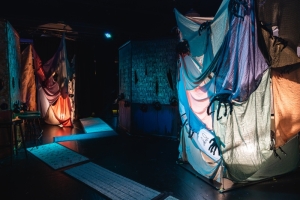
For its sixth Halloween season, Rough House Theater Co. has transformed Steppenwolf’s Merle Reskin Garage into a spectacular puppet haunted house. Last year I visted House of the Exquisite Corpse V: BLOOD & PUPPETS, and this year’s installment feels familiar in form but distinct in approach. The experience unfolds across six short puppet performances, each about seven minutes long and staged in its own small, enclosed box. Instead of sitting in seats, audience members peer through peepholes and listen through headphones, becoming voyeurs of a series of strange, self-contained worlds.
Last year’s “Blood & Puppets” theme offered a direct prompt. This time, LULLABIES gives its six creative teams a more abstract one, and they take it in folkloric, tall-tale directions. The stories draw on the uneasy promise at the heart of a lullaby: sleep, and you’ll be safe; stay awake, and you’re powerless. The audio narration felt especially full and impactful this year, adding texture to the stories and pulling listeners further into each room.
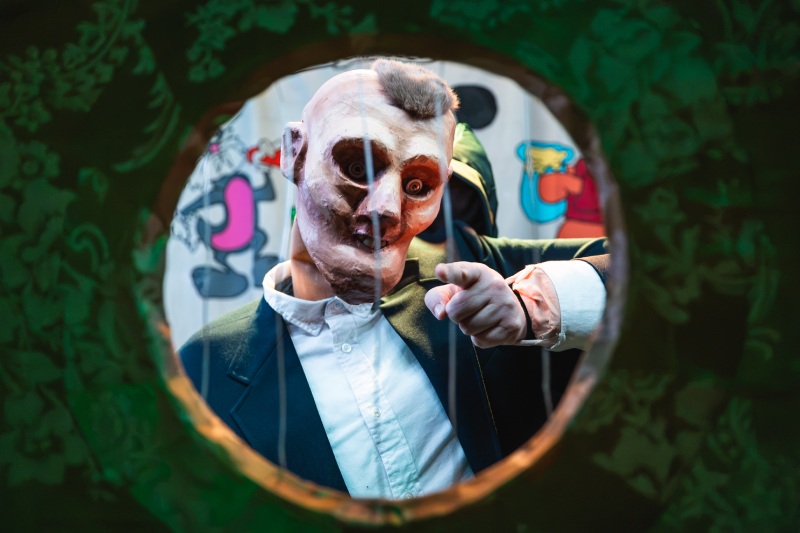
Jumping Jack Money. Photos by Greg India.
Exquisite Corpse's unique format gives each team room to experiment and draw on personal or cultural connections to lullabies. This variety is one of the production’s greatest strengths. Puppetry appears in many forms, often layered together: shadow puppets, hand puppets, and full-body puppets all share these small spaces. You’re close enough to notice the details in the figures and the mechanics of their movement, while the peepholes keep you just outside the worlds you’re watching.
That close-up view, combined with each team’s total freedom to construct an original world, raises expectations and makes the weaker moments more noticeable. There are always limits in live theater, but it’s disappointing when a story sets up a moment and then declines to stage it. “Jumping Jack Money” is a hilarious, cheeky piece, and its audience interaction is among the evening’s most charming. All the more frustrating, then, is that when the central conflict arrives, the piece avoids the playful challenge of staging a puppet fight and opts for a blackout that isn’t even dark enough to make the absence feel intentional. Another piece introduces a tornado—a chance for an intricate, dynamic effect alongside its many forms of puppetry, then buries the moment under a simple projected animation. Both left me wishing the production had followed through on the possibilities it had deliberately established.
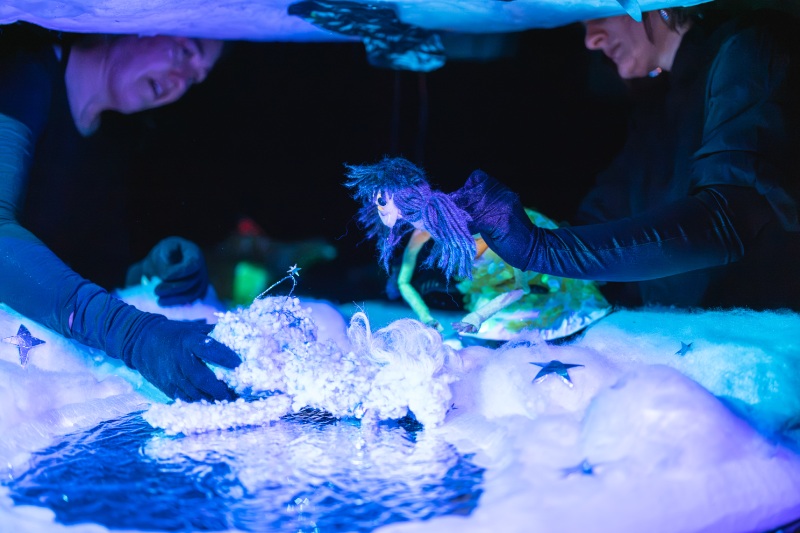
don’t you want to live it? don’t you want to live your dream?
My favorite stories show what the format can do when its ideas and staging work in tandem. Designed by Caitlin McLeod, “Hushaby hush, you’re not going with them,” performed by Finn Bradley, Eddy Barber-Rozema, Rachel Hartmann and Emilie Wingate, uses an angled castle set with meticulous detail. From all angles, the perspective gives the scene the feeling of a storybook illustration, making it an especially apt fit for a show about the tales we tell to get children to sleep.
The final piece, “don’t you want to live it? don’t you want to live your dream?,” created by J. Felix and Abby Palen and performed by Mallory Limbrell and Shannon Twenter, makes memorable use of its floating, moving set. The performers move around it, giving the puppets space to transform along with the scene. It’s a playful, visually inventive take on lullabies and a strong finish to the sequence.
The experience design has also become more cohesive since last year. Each performance space’s exterior peepholes now feel connected to the story inside, and the paths between each story, between and around the boxes, carry a more unified atmosphere, giving the six distinct rooms a shared setting: an eerie, wonderful night of lullabies and puppets!
House of the Exquisite Corpse VI: LULLABIES runs at Steppenwolf’s Merle Reskin Garage through November 1. Tickets are available at roughhousetheater.com/tickets.
BrightSide’s Addams Family Musical Revives the Wonderfully Weird World of the Addams Clan
They're creepy and they're kooky, Mysterious and spooky, They're altogether ooky, The Addams Family.
Yes, ooky.
BrightSide Theatre’s production of The Addams Family Musical at the Theater at Meiley Swallow Hall feels like stepping back into the wonderfully odd world of a family we’ve all grown up with. There’s an immediate charm in seeing Gomez and Morticia - the passionately devoted, darkly elegant heads of the Addams clan - presiding over their spooky, loving household with the same theatrical flair that made them iconic. With a book by Marshall Brickman and Rick Elice and music and lyrics by Andrew Lippa, the show’s blend of gothic quirk, musical comedy warmth, and big-hearted family chaos lands with a personal, familiar joy that makes this staging especially inviting. And right at the center is Wednesday Addams, their sharp tongued, deadpan daughter whose unexpected leap into romance sets everything spiraling.
In this musical comedy, Wednesday has fallen in love with Lucas Beineke, a sweet, decidedly “normal” young man from Ohio. Determined to prove she’s ready for something real, she asks her parents to host a dinner so the two families can meet - but she also begs Gomez to keep her engagement a secret from Morticia. That single request throws Gomez into a hilarious moral crisis, while Morticia senses something is off and the rest of the Addams household prepares for an evening guaranteed to go sideways. When the straight-laced Beinekes arrive, their collision with the gloriously eccentric Addamses sparks a night of confessions, misunderstandings, unexpected alliances, and more than a few supernatural surprises. What unfolds is a heartfelt, funny, and delightfully macabre exploration of love, loyalty, and the beautifully strange ways families learn to accept one another - quirks and all.
BrightSide’s production thrives on the strength of its performers, and this cast brings the Addams world to life with personality, precision, and a magnificently off-center spirit.
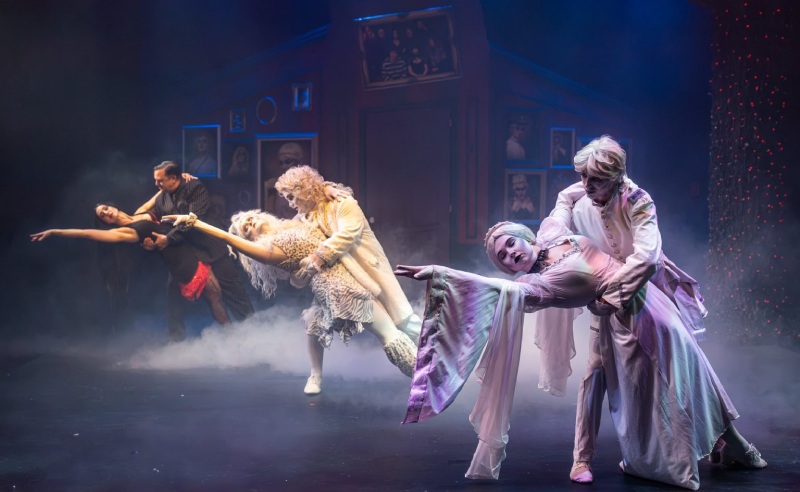
Scott Kelley and Samatha Keret (rear) as Gomez and Morticia and Ancestors in Brightside Theatre’s The Addams Family Musical. Photos by CM Stage Photography.
At the center of the production are Scott Kelley’s Gomez Addams and Samantha Keret’s Morticia Addams, who anchor the show with an easy chemistry that makes their partnership feel lived in and genuinely affectionate. Their banter and romantic interactions are fantastic - playful, sharp, and full of the kind of idiosyncratic mutual understanding that makes their marriage the emotional core of the evening. Kelley gives Gomez a warm, slightly frantic presence, the kind of theatrical bravado that feels both funny and sincere. Keret, with her beautiful voice and cool, elegant presence, matches him beat for beat, creating a dynamic that feels both grounded and pleasantly heightened. Together, they knock their roles out of the ballpark.
The ensemble - from the Addams clan to the buttoned-up Beinekes, along with the ghostly Ancestors who linger in the house until Wednesday’s journey toward love sets them free - brings strong energy and cohesion to the production, giving the show a vibrant foundation for some standout performances.
Lauren Mathews’ Wednesday Addams is terrific, offering a Wednesday who is smart, guarded, and brimming with the dry, deadpan wit audiences expect - but also carrying the emotional uncertainty of someone stepping into adulthood faster than she planned. Her performance captures a teenager caught between loyalty to her wonderfully strange family and the terrifying possibility of real change. Because the story ultimately revolves around love - romantic, familial, and everything in between - Mathews becomes the hinge of the entire narrative, and she handles that responsibility with clarity and confidence.
Collin Borisenko’s Uncle Fester adds a welcome dose of sweetness and eccentricity, leaning into Fester’s gentle oddball nature without tipping into caricature, while Amy Arbizzani’s Alice Beineke provides some of the evening’s biggest laughs as a tightly wound suburban mom whose unraveling becomes a comedic highlight. Arbizzani’s timing - and her ability to really belt when the moment calls for it - turns her musical outbursts into genuine showstoppers.
BrightSide’s creative team shapes this production with care and a clear affection for the material. Under De Haddad’s direction, the musical moves with clear, unfussy ease, balancing the story’s humor and heart while keeping the unconventional Addams world feeling cohesive and inviting. Shane Brown’s choreography adds light, well placed movement that supports the storytelling without crowding the stage, giving each number a clear, character focused lift. Phil Videckis leads the music with steady assurance, keeping the score’s personality and emotional beats aligned with the action. Cheryl Newman’s costumes offer a thoughtful blend of familiar Addams silhouettes and clean, stage ready designs, while Kurt Ottinger’s lighting brings subtle shifts in mood and color with just enough theatrical shadow to frame the world effectively. The production’s scenic design, crafted by Ariel Mozes, provides a space that feels both spooky and welcoming - a home that fits the Addams tribe and the story unfolding within it. One of the production’s most engaging details is the way the Ancestors drift in and out of the family portraits, turning the walls of the Addams home into a living gallery that observes the action as it unfolds.
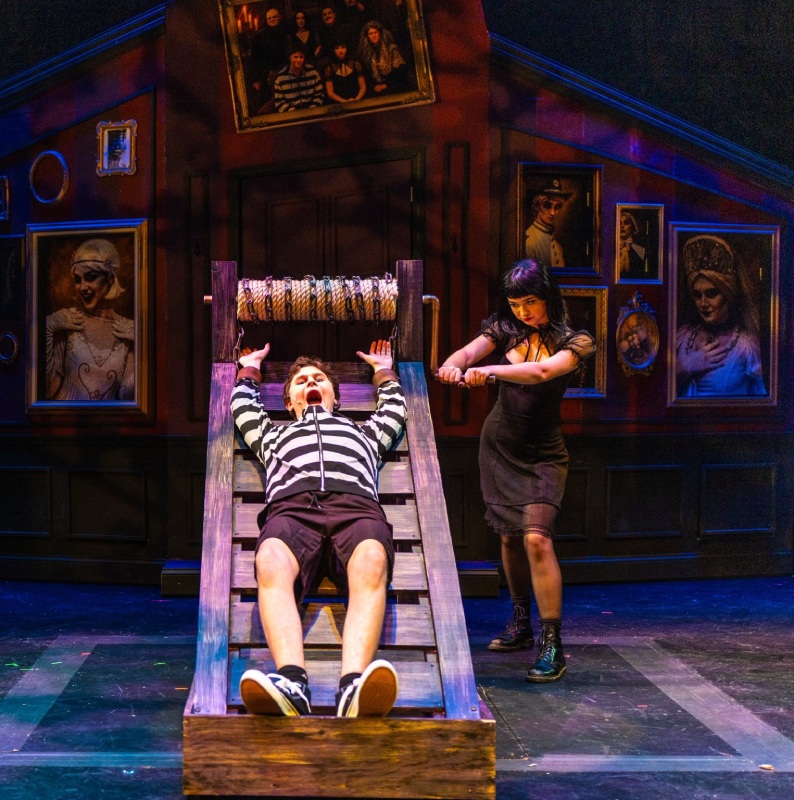
Pugsley and Wednesday Addams (Carson Kelley and Lauren Mathews) in Brightside Theatre’s The Addams Family Musical.
This is a funny show that is all about love, and BrightSide delivers that humor with a light, playful touch that keeps the audience laughing. And even when some of the jokes are predictable, they still land, because the delivery, timing, and sheer Addams‑style absurdity make the familiar feel fun rather than tired. I did wonder whether comedy born sixty years ago would still resonate with today’s crowd, but the production blends the classic Addams deadpan with a few modern winks - including some sly innuendo and contemporary asides - that make the jokes feel fresh without betraying the spirit of the original. The crowd was a mix of longtime Addams fans and newer generations, something made instantly clear when the familiar theme kicked in - a handful snapped right on cue while others clapped along. It was a fun blend of reactions, and the overall effect showed that the humor lands for everyone.
Big musical moments like When You’re an Addams burst with playful choreography and gothic silliness, setting the tone right from the start. Later, Full Disclosure turns a family dinner into a brilliantly chaotic spectacle, layering jokes, reveals, and ensemble energy in a way that feels both sharp and amusingly messy. Morticia’s Just Around the Corner is another highlight - a charming bit of dark humor built around her cheerful pun that “death is just around the coroner… get it?” delivered with exactly the kind of melodramatic glint the character thrives on.
For so many of us, The Addams Family began in grainy black and white reruns on TV - the kind you’d stumble upon on a quiet afternoon, or watch curled up on the couch, instantly pulled into that wonderfully odd little world. Those episodes became part of childhood in a way that sticks, shaping our sense of humor and giving us characters who felt strange, sweet, and strangely familiar all at once. Seeing the Addamses still make people smile today - onstage, in full color, with all their offbeat charm intact - is a reminder of how enduring they are. Decades later, they’re still beautifully weird, still welcoming, and still capable of bringing out that same simple, shared joy.
BrightSide Theatre’s The Addams Family Musical is recommended, offering a spirited, nostalgic, and thoroughly enjoyable night out for audiences of all ages. The production runs October 2–18, 2026 at the Theater at Meiley Swallow Hall at North Central College, located at 31 S. Ellsworth St. in Naperville. With an estimated running time of 2 hours and 30 minutes, including intermission, it’s an evening that delivers plenty of laughs, charm, and quirky family fun - a welcome return to the wonderfully weird world of the Addams clan.
Chicago City Opera Delivers a Rare Operatic Haunting with Der Vampyr
With Halloween creeping closer, there’s something fitting about revisiting one of opera’s earliest flirtations with macabre horror - especially in a production presented and performed by Chicago City Opera (COT). Der Vampyr may not enjoy the mainstream familiarity of later supernatural works, but its mix of moonlit superstition, doomed romance, and aristocratic menace makes it an ideal October offering. As audiences lean into the season’s appetite for the eerie, Marschner’s opera emerges as a surprisingly modern ancestor to everything from Victorian melodrama to contemporary horror musicals.
Though often treated as a standalone curiosity, Der Vampyr has a lineage that begins well outside the opera house. The story originates with John Polidori’s 1819 prose tale The Vampyre, one of the first works to codify the seductive, aristocratic vampire archetype. Polidori’s narrative was adapted into a German stage play by Heinrich Ludwig Ritter, whose dramatization became the direct source for Wilhelm August Wohlbrück’s libretto. Heinrich Marschner’s 1828 opera builds on Ritter’s theatrical version, shaping the material into a darkly romantic, musically driven narrative that blends early Romantic lyricism with gothic theatrics. In short: Polidori’s story inspired Ritter’s play, and Ritter’s play became the foundation for Marschner’s opera.
Set in early 19th century Scotland, the opera follows Lord Ruthven, a charismatic nobleman cursed with vampirism and bound to claim new victims before dawn or face eternal damnation. After surviving a near fatal attack, the young hero Edgar becomes unknowingly entangled in Ruthven’s hunt. Ruthven first targets the innocent Janthe, luring her to a ruined castle under the guise of seduction, and later sets his sights on Malwina, Edgar’s beloved, whose wedding night becomes his final opportunity to fulfill his deadly pact. As Edgar pieces together the truth, the opera accelerates toward a frantic race against sunrise: Ruthven’s identity is exposed, his supernatural bargain collapses, and the community rallies to save Malwina as the vampire is ultimately destroyed. What remains is a blend of gothic suspense, romantic rescue, and early Romantic moral drama - a seasonally perfect slice of operatic horror as Halloween approaches.
Jeremiah Strickler commands the evening as Lord Ruthven, delivering a performance that blends aristocratic charm with a chilling, predatory stillness. His presence anchors the production - vocally assured, theatrically magnetic, and always in control of the opera’s gothic pulse. Opposite him, Jordan Loyd brings a clear, earnest intensity to Edgar Aubry, shaping the role with a bright tenor and a palpable sense of moral urgency. Loyd had some of the most spectacular and heartfelt vocal moments of the evening, particularly toward the end of Act II as he reflects on his past love. Jessie Lyons’ Malwina adds welcome tenderness, her lyrical phrasing and grounded sincerity adding to the opera’s romantic core. Ariel Emma’s Janthe provides one of the night’s most striking early moments, her brief arc handled with vivid color and fearless commitment, and some of the notes she held were genuinely astounding - the kind that stop the room for a beat. Keaton Payne’s Humphrey von Davenaut provides a sturdy, authoritative counterweight, shaped by both his assured delivery and his expressive, sharply drawn presence. Meanwhile, Molly Clementz (also the production’s graphic designer) brings Emmy Perth to life with bright energy and an impressive finesse that lifts every moment she’s given, adding flashes of warmth, wit, and a polished musicality - especially in the way she shapes and sustains her notes with such control and clarity.
Bat Collazo’s George Dibdin and Kevin Wheatle’s John Berkley round out the ensemble with crisp, well-shaped character work that keeps the world of the opera humming with specificity.
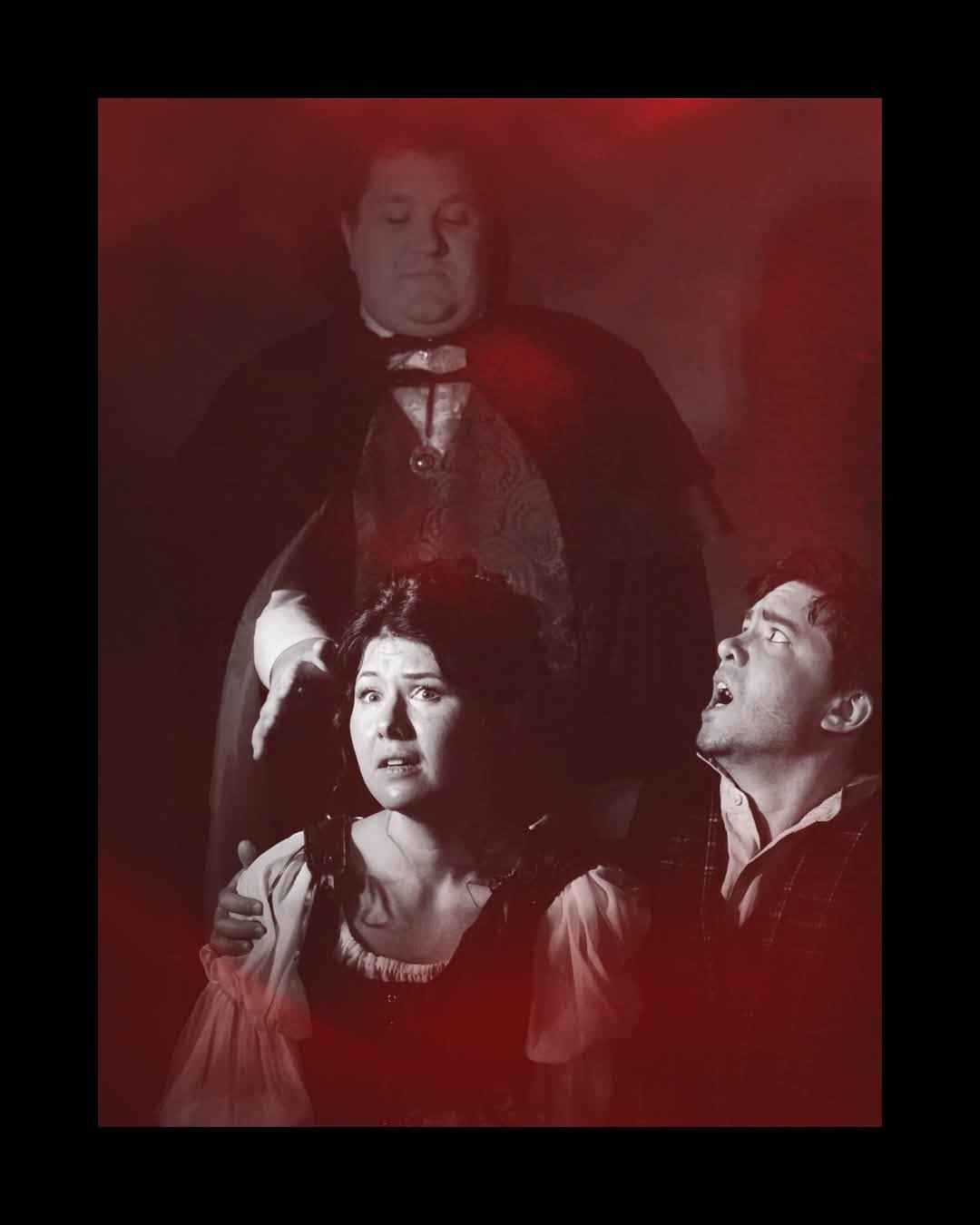
Jerimiah Strickler (rear) Molly Clemenntz (left) and Bat Collazo in Chicago City Opera's Der Vampyr.
One of the unexpected pleasures of the evening was simply hearing each singer on their own - every voice carrying its own color, character, and emotional weight. But when paired, those timbres intertwined with a striking naturalness, and in the moments when all eight sang off one another at once, the result was nothing short of exquisite. The ensemble sound had a richness and immediacy that felt almost architectural, each voice reinforcing the next until the room seemed to vibrate with a unified, resonant force. It was a reminder of how thrilling Marschner’s writing can be when performed by artists who listen as intently as they sing.
Behind the scenes, Alexis Enyart conducts with sharp dramatic instinct, shaping Marschner’s score with clarity and momentum. SarahAnn Sutter’s direction deepens the production’s impact, treating Der Vampyr not merely as gothic spectacle but as a living, breathing psychological drama. She embraces the opera’s supernatural flair with confidence - the shadows, the proximity, the sudden shifts in tone - yet she never lets the human stakes slip away. Sutter has a keen sense for spatial storytelling, using the venue’s architecture to heighten tension and intimacy; she sends performers through the aisles and along the home’s sweeping historic staircase, activating much of the house as part of the dramatic landscape. Her staging choices reveal a director who understands how early Romantic horror works best: not through excess, but through precision, ambience, and emotional clarity. Supported by Jordan Crice’s deft piano work and Adam Nicholson’s distinctive set design, the result is a production where every element feels intentionally placed and dramatically charged. Thanks to this talented cast and creative team, Chicago City Opera builds a world where early Romantic horror feels both stylish and surprisingly immediate.
Although Der Vampyr travels through a handful Chicago area venues during its run, the performance I attended on opening night unfolded inside the storied Colvin House - a location that feels almost predestined for this opera. Colvin House, beautifully placed across the street from Lake Michigan on the corner of Thorndale Avenue and Sheridan Road, proves to be an inspired setting for Der Vampyr, its historic architecture and intimate, richly textured rooms amplifying the opera’s gothic mood in ways a traditional proscenium simply can’t match. The building’s carved woodwork, shadow friendly corners, period furnishings, and old-world elegance create a natural sense of suspense and closeness, allowing the audience to feel almost inside the drama rather than observing it from a distance. The scale of the space heightens the tension - Ruthven’s entrances feel more dangerous, Janthe’s fate more immediate, Malwina’s peril more personal. Colvin House becomes a living extension of the opera’s supernatural world and a perfect match for Marschner’s early Romantic horror.
Despite all its strengths, the evening wasn’t without a minor but noticeable drawback. Although brief stretches of dialogue were exchanged in English, the opera itself is sung in its original German, making the surtitles essential for most. Unfortunately, the monitor displaying those subtitles sat off to the front side and too low to be easily seen by much of the audience; only those in the unobstructed front section had a consistently clear view. Sitting in the third row opposite the monitor side, I was able to catch most of the surtitles when first‑row head movement allowed, but many around me – and further back - were blocked entirely. I’m no set designer, but raising the monitor and centering it - even if it encroached slightly into the stage picture - would make the surtitles far more accessible, a small trade off that would greatly improve audience experience. In the meantime, I strongly recommend that attendees read the Act I and Act II synopsis in the program before the performance begins; with that context in hand, most will have a solid grasp of the unfolding drama even if the surtitles prove difficult to see.
Regardless of that small hiccup, the opera itself remained a beautiful, wonderfully performed experience - rich in mood, artistry, and musical power.
Der Vampyr is recommended as a rare and atmospheric experience - the kind of intimate, site specific opera that feels tailor made for October. For audiences looking to embrace the season with something truly unique, this production offers a gothic thrill you won’t find anywhere else. Upcoming performances include Wednesday, October 7 at Colvin House (7pm), Friday, October 9 at Fulton Street Art Center (7pm), and Sunday, October 11 at Skokie Theatre (3pm).
Frankenstein at Studebaker Theater adds performances for Halloween run
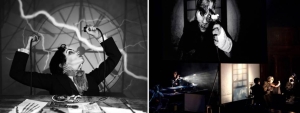
Chicago's historic Fine Arts Building and Studebaker Theater are thrilled to announce their Halloween co-production of Manual Cinema's acclaimed Frankenstein has added two additional performances due to popular demand on Wednesday Oct. 28 at 7:30 p.m. and Saturday, Oct. 31 at 2 p.m. The production runs for five performances only, October 28–November 1, 2026, at the Studebaker Theater (410 S. Michigan Avenue). For tickets and more information, visit fineartsbuilding.com/frankenstein.
In Manual Cinema's thrilling version of the classic Gothic tale Frankenstein, the Chicago-based Emmy Award-winning performance collective imaginatively combines shadow puppetry, cinematic techniques, and live sound effects and music in a haunting show unlike any other. The production stitches together the fictional story of Frankenstein with the biography of the original novel's author, Mary Shelley, to create an unexpected tale about the beauty and horror of creation.
Frankenstein is adapted from the novel by Mary Shelley, with a concept by Drew Dir. The production is devised by Drew Dir, Sarah Fornace and Julia Miller. Original music and sound design are by Ben Kauffman and Kyle Vegter.
Tickets for Frankenstein at the Studebaker Theater (410 S. Michigan Avenue, Chicago) are now on sale for $35-$85, with student tickets available for $25 with ID. For more information and to purchase tickets, visit fineartsbuilding.com/frankenstein.
Frankenstein performance times are:
Wednesday, Oct. 28 at 7:30 p.m.
Friday, Oct. 30 at 7:30 p.m.
Saturday, Oct. 31 at 2 p.m. and 7:30 p.m.
Sunday, Nov. 1 at 3 p.m.
About the Fine Arts Building and Studebaker Theater
The Fine Arts Building, which celebrated its 125th anniversary in 2023, is a home for art in all forms: from pioneers like Poetry magazine's founding publisher Harriet Monroe, architect Frank Lloyd Wright, illustrator W. W. Denslow, sculptor Lorado Taft and the Chicago Little Theatre, to the ongoing legacies of painters, musicians, booksellers, puppeteers, dancers, photographers and craftspeople who inhabit the building today, the Fine Arts Building is buzzing with more than a century of Chicago creativity and innovation.
A Chicago Landmark since 1978, the building features original Art Nouveau murals from the late 19th century and the Studebaker Theater, one of the city's oldest and most significant live theatrical venues. Following a major multi-million-dollar renovation of the Studebaker led by Berger Realty Group and completed in 2022, the theater has been home to NPR's popular news quiz show "Wait Wait... Don't Tell Me!" and has hosted performances from new musicals including 44: The Obama Musical, Roald Dahl's The Enormous Crocodile, and Jim Henson's Emmet Otter's Jug-Band Christmas, along with productions Ava: The Secret Conversations starring Elizabeth McGovern and Manual Cinema's Christmas Carol. For more information, visit fineartsbuilding.com.
About Manual Cinema
Manual Cinema is an Emmy Award-winning performance collective, design studio, and film/video production company founded in 2010 by Drew Dir, Sarah Fornace, Ben Kauffman, Julia Miller and Kyle Vegter. Manual Cinema combines handmade shadow puppetry, cinematic techniques, and innovative sound and music to create immersive stories for stage and screen. Using vintage overhead projectors, multiple screens, puppets, actors, live feed cameras, multi-channel sound design, and live music, Manual Cinema transforms the experience of attending the cinema and imbues it with liveness, ingenuity, and theatricality.
The company was awarded an Emmy in 2017 for "The Forger," a video created for The New York Times, and named Chicago Artists of the Year in 2018 by the Chicago Tribune. Their shadow puppet animations were featured in the 2021 film remake of Candyman, directed by Nia DaCosta and produced by Jordan Peele's Monkeypaw Productions. In collaboration with the Obama Foundation and Batwin + Robin Productions, Manual Cinema created two animated films for the Obama Presidential Center Museum in Chicago, Ten Letters a Day and Power of Place.
Recent productions include Leonardo! A Wonderful Show About A Terrible Monster, based on books by Mo Willems, an adaptation of Charles Dickens' A Christmas Carol, and a revamped production of The Magic City, based on Edith Nesbit's 1910 novel. In 2023, Manual Cinema completed production on their first self-produced short film, Future Feeling, and toured with folk rock band Iron & Wine the following year. In Summer 2025, Manual Cinema premiered their latest feature production, The 4th Witch—a bold and imaginative inversion of Macbeth that is now touring.
Review: Kokandy's 'Jekyll & Hyde' at Chopin Theatre

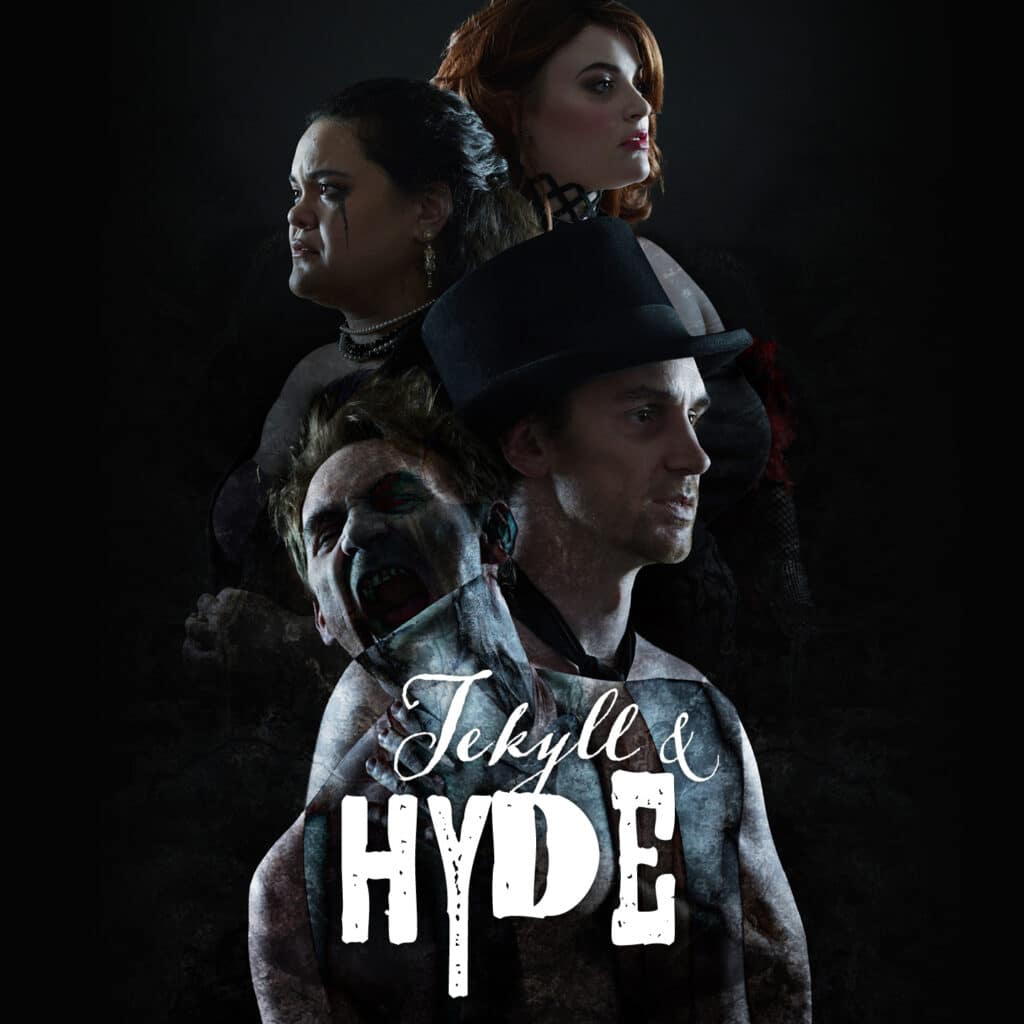
‘Jekyll & Hyde’ returns to Chicago for the first time in over 15 years. Kokandy Productions follows their recent hit ‘Amelie’ with a much-anticipated revival of the 90s cult horror pop opera. Director Derek Van Barham brings his stylish vision to life with a cast of scary good voices.
Kokandy Productions has long established themselves as a theatre company that specializes in “misfit toys” musicals. In that regard ‘Jekyll & Hyde’ seems like a perfect show for their distinct niche. Though the original Broadway production was by all accounts a hit and ran for almost four years, critics were divided. Originally produced in Houston in 1990, it would take 7 years and a national tour before it would open on Broadway. The original Broadway production is perhaps most notable for casting David Hasselhoff in its final run.
‘Jekyll & Hyde’ has since become a fan favorite among those with an affinity for shows like ‘Phantom of the Opera’ and ‘Sweeney Todd’. Van Barham thankfully lifts the source material out of the gauche 1990s-style of overblown period piece musicals. Instead, his version is entirely contemporary with thrilling lighting and steam punk costuming.
One reason ‘Jekyll & Hyde’ isn’t revived often is that you need a really good cast of singers as this show is mostly sung-through. Kokandy’s cast is stacked with amazing vocalists starting with David Moreland in the dual role of Jekyll and Hyde. His powerful voice sways naturally between the darkness of Hyde and the fading goodness of Jekyll. It’s also a rare experience for a press night audience to hold for close to a minute for applause, but Ava Lane Stovall as wayward Lucy is this production’s secret weapon. Her stirring rendition of ‘Someone Like You’ brings Act I to a standstill of roaring applause. Throughout the show Ava Lane Stovall’s incredible voice brings the tragic character of Lucy to life in vivid detail. Her name may not be in the title, but with a voice like that, this is certainly a Justice-for-Lucy production.
Fans of 1990s era musicals are well aware of the cringy costumes and over-the-top staging that often overshadowed quality. ‘Jekyll & Hyde’ is surely a product of its time. Perhaps better off forgotten in some ways. However, Derek Van Barham treats this show like it’s brand new. Kokandy’s ‘Jekyll & Hyde’ can’t necessarily hide the meaninglessness of its lyrics, but it puts so much gloss on the production that lyrics feel incidental. This is a show about incredible voices and stylish staging.
Lighting design by G “Max” Maxin IV is genuinely striking. Faces are bathed in deep reds and cool blues, casting eerie shadows about the Chopin Theatre. The tightly drawn set by designer Sotirios Livaditis captures all the soaring voices and beautiful harmonies with such simplicity proving less is often more.
Halloween season is drawing to a close, but Kokandy’s ‘Jekyll & Hyde’ is here for the winter. Their near-perfect production breathes new life into a show many know but few have seen. If you missed out on this Blockbuster in the 90s, now is your chance to see an elevated revival. Go now or risk waiting another 15 years.
Extended through January 10th at Kokandy Productions at Chopin Theatre. 1543 W Division St. 773-278-1500
Chicago Shakespeare Theater Terrifies and Astounds with Paranormal Activity

Lou (Cher Álvarez) and James (Patrick Heusinger) are in their bedroom. They are so focused on each other that they don’t notice the flashing light in the bedroom down the hall. The catch? Lou and James are the only ones in the house. So that leaves the question – who is controlling the flashing lights?
Many of us are familiar with this moment in a horror film. The first scare is crucial and sets us up for what we are about to experience. We may not know exactly what is happening, but we do know that this simple game with the lights suggests that all is not quite normal in this house. Lou and James are not alone, and whether or not we are ready, we are soon going to learn what is keeping them company.
However, this is not a film. This is a horror play, and while the moment provides a similar purpose, you might find that the experience is quite different. Gasps could be heard across the house at this particular performance. Looking around, folks were pointing to fellow audience members – making sure that they too took in the flashing lights. Whispers could be heard, and suddenly, it felt like we were part of the performance. As the scares grew over the course of the piece, reactions only intensified. Audience members shouted, screamed, and even at times tried to warn the characters of what they were clearly missing. Director Felix Barrett and his design team skillfully create what might feel like an immersive experience. As the tension on stage grew, I personally could feel the same happening to the audience surrounding me. To put it simply – we were hooked, and there was no escape until we finally got our answers.
Writing by Levi Holloway, Paranormal Activity follows married couple James and Lou who move from Chicago to London to escape their dark past. We slowly learn that their previous home was haunted, and they assumed that a full ocean could make that go away. However, they soon discover that it’s not always a place that is haunted. Sometimes it’s people, and whether or not they are ready, it’s time to confront their past before it’s too late.
That which truly pushes the experience over the top is the work of Illusions Designer Chris Fisher – along with the collaboration of Associate Illusions Designer Daniel Weissglass and Illusions Consultant Skylar Fox. The stage magic is often hard to grasp with how authentic it feels, and you may find yourself wondering if you even believe what is in front of you – much like the characters on stage.
We witness the couple at the center slowly unravel – particularly James. As with so many horror stories, he begins as a non-believer. As the ghostly interactions become harsher and harder to avoid, we see him question everything he ever knew. Both Álvarez and Heusinger perform quite a feat. As we witness their marriage completely fall apart at the mercy of the hauntings, you might find yourself feeling sorry for the genuine relationship they so clearly set up at the beginning.
With haunting stage magic and a story that takes no prisoners, Paranormal Activity is not just a play – this is an event. Fans of the horror genre will not be disappointed. This is an experience that keeps you guessing from the moment the curtain rises to the last glimmer of light at its conclusion.
HIGHLY RECOMMENDED
Run Time: 2 hours, with intermission
Paranormal Activity runs through November 2 at Chicago Shakespeare Theater – 800 E. Grand Avenue.
Review: House of the Exquisite Corpse V: Blood & Puppets from Rough House Theater Co. at Steppenwolf's Merle Reskin Garage

More than a haunted house and not quite a play, the House of the Exquisite Corpse series lives somewhere between immersive theater and a live-action episode of Black Mirror.
For the fifth year in a row, Rough House Theater Co. is haunting Steppenwolf's Merle Reskin Garage Theatre with House of the Exquisite Corpse V: BLOOD & PUPPETS. This production-experience hybrid is unsettling, uncanny, and unlike anything else running in Chicago this Halloween season.
The show consists of six puppet performances, each roughly five minutes long, staged in dark, enclosed rooms. Positioned more as voyeurs than viewers, the audience observes each performance through peepholes cut in the room’s walls and listens through headphones. It’s an experience like no other, immersing you in a world entirely, even as you watch it from the outside.

LETTING -Creators Nina D'Angier & Madigan Burke Puppetteer Amandatron 5000.
Although you may be tempted, as I was, to take this year’s blood-and-puppets theme literally, expecting guts and gore, co-directors Felix Mayes and Corey Smith encouraged artists to explore “blood” more metaphorically. The results are striking. Across the six rooms, blood takes many forms: as a symbol of life, decay, lineage, legacy, intimacy, and rupture. Each room also offers a radically different world. One might transport you to the cluttered lab of a deranged scientist, another to a barren, surveilled interior, another to an eerily windswept desert.
The artistry on display is staggering, extending far beyond set design. Each vignette – created by a different team of artists – interprets the theme in personal and provocative ways, resulting in a thrilling range of styles and techniques. The puppetry alone shifts dramatically from room to room, moving from delicate shadow work to oversized, wearable creatures and full-body figures that act like natural extensions of the performer’s body. Some rooms tell tight, plot-driven stories; others are impressionistic and mood-driven, favoring feeling over narrative. Across the board, the performances are intriguing and deeply theatrical – you might come for the scares, but you’ll stay for the craft.
Of course, none of this would be possible without the collective effort of the full production team. The co-directors have built more than a series of puppet shows: they’ve created a platform for experimentation. Puppetry, an art form that’s far too often dismissed and infantilized, takes center stage in House of the Exquisite Corpse, revealing its full expressive range. A space where this kind of work is possible is rare, and Rough House has built one where artists can be unapologetically weird, bold, and free – a testament to what independent theater can be when creators are trusted to follow their wildest ideas.
Whether you're a horror fan, a regular theatergoer, or just looking for something truly unique to do this spooky season, House of the Exquisite Corpse delivers. It may not make you scream, but it will definitely make you squirm.
House of the Exquisite Corpse V: BLOOD & PUPPETS is haunting The Merle at Steppenwolf Thursdays, Fridays, and Saturdays through November 1. Tickets are available at https://roughhousetheater.com/house-of-the-exquisite-corpse
Before you go, please note that the experience requires walking and standing for extended periods, as well as the use of over-ear headphones. Rough House is committed to accessibility and has made detailed information and request forms available at https://roughhousetheater.com/accessibility.
*This review is also shared on https://www.theatreinchicago.com/!
Bram Stoker's 'Dracula' at Brightside Theatre is the ultimate Halloween treat with just the right amount of bite!

Brightside Theatre’s rendition of Bram Stoker’s Dracula, adapted by Stephen Dietz, captivates from the opening scene to its climactic finale. Ever since the 1992 Francis Ford Coppola film with Gary Oldman, Bram Stoker’s Dracula has fascinated me. It was a delight to see Brightside Theatre’s cast and crew brilliantly capture the excitement, romance, and terror of this classic tale. Each professional performer brought their unique talents to the show, creating an unforgettable experience.
Bram Stoker’s Dracula is a gothic horror story that follows Jonathan Harker, a young lawyer, who travels to Transylvania to help Count Dracula purchase a London estate. Harker soon discovers that Dracula is a vampire intent on spreading his undead curse to England. Meanwhile, Dracula's sinister influence spreads, threatening Harker's fiancée Mina and her friend Lucy. While Renfield eagerly awaits his master’s arrival, a group led by Professor Van Helsing joins forces to thwart Dracula's plans, resulting in a thrilling battle between good and evil. The tale explores themes of fear, seduction, and the clash between modernity and ancient evil.

Lucy (Julia Hope Budd) and Seward (Adam Boczar) in Dracula
The entire cast is excellent. Greg Kolack shines as Renfield, bringing immense energy and pathos to the role of Dracula's insane, bloodthirsty slave. Caitlin Wolfe captures Mina's innocent charm with a thoughtful and intelligent grace, making her the perfect target for Dracula's dark desires. Brady McNeil delivers a compelling performance as Jonathan Harker, convincingly portraying his transition from a rational businessman visiting Dracula's castle to a broken, mentally disturbed soul after enduring the bloody, sexual rituals of Dracula’s vixens. Julia Hope Budd delivers an exceptional and multifaceted performance as Lucy, the innocent victim who succumbs to Dracula's bloodthirst and transforms into a vampire. Budd lights up the stage with her sensuality and humor in scenes where she's pursued by suitors. As she transforms into a vampire, she remains equally compelling and thrilling to watch.
Also delivering a strong performance is Mike Boyna, who excels as Van Helsing, bringing a mature presence and delivering words of wisdom that resonate deeply with the audience in Steven Dietz's well-written adaptation. Seward is superbly played by Adam Boczar. His deep love for Lucy is clear, despite her referring to him as a "true friend." Seward's love and respect for Lucy is palpable, especially in the way he gently touches her wrist to take her temperature, as if overcome with emotion at the honor.
Of course, Danny Parrott excels as Dracula, bringing a spooky energy to the role. Parrot's strong, graceful, and sensual portrayal as he stalks his victims showcases both sides of Dracula—the powerful, commanding seducer and the violent, selfish monster capable of great cruelty and murder.
The vixens, portrayed by Erica Harrington, Daria Koon, and Kirstin Palatinus, were each sensuous and frightening, draped in beautiful silk robes.

The cast of Bram Stoker's Dracula
Throughout the play the production's lighting and sound effects, crafted by set designer Jeff Sand, Jay Fontanetta, and Kurt Ottinger, were exceptional, including its clever use of multimedia. I also thoroughly enjoyed Cheryl Newman's well-fitting and multilayered period costumes. Each outfit perfectly suited both the actors and the era, particularly the women's intricate, corseted silk ensembles.
During the play’s intermission, I spoke with Jeffrey Cass, Brightside’s Artistic Director, and Julie Ann Kornak, the company’s Executive Director and co-founder, praising their excellent work in creating the space—a delightfully intimate three-quarter thrust theater with comfortable seating, great sight lines, and effective special effects lighting. I was thrilled to learn that their upcoming season will feature more exciting productions like Dracula, including Jekyll and Hyde the Musical, the ever-romantic Midsummer Night’s Dream, and the uplifting musical comedy Pippin!
Skillfully directed by Jay Fontanetta, this thrilling, scary, and sensual production of Dracula is a must-see for audiences of all ages. It's the perfect Halloween treat for adults looking to celebrate the holiday without the usual haunted house fare!
Dracula is being performed at Brightside Theatre in Naperville through November 3rd. For tickets and/or more show information, click HERE.
Revenge Is Served Cold W/ A Side Of Human Flesh in Bill Daniel's 'Hell Followed With Her'

How many times have you heard someone say they went to see a western/zombie play? Most people would dismiss the idea of a western/zombie story especially one being played out on a stage. The two genres don’t seem to mesh well together when you put them in the same sentence. The western is a genre of post-Civil War America. The genre comes with a bravado similar to Arthurian mythology. The zombie genre has mostly been a contemporary tale. Usually a terrifying result of some wacky science experiment. Since The Walking Dead or Zombieland, the genre has seen a resurgence. We enjoy playing with the idea of “what if". The zombie and/ or zombie invasion has become a way to study relationships when love ones die and resurrect into a dangerous, poisonous being. Bill Daniel’s Hell Followed With Her attacks this study and blends it with drama you can only find in a well-written Western.
Willow Parker is a hardened bounty hunter out for revenge. For the two years, she’s travel far and wide to locate a man named Glanton, who muredered her family after escaping prison. She finds him in Dodge, Texas, along with a few other shady characters in a dimpy lit saloon. The zombie invasion starts of as subtle, with the town’s doctor mulling over the unusual bite marks he discovered from the last thirteen patients. As tensions skyrocket, the disease spread all over Dodge, and the sick have their sights set on the saloon where they can hear gunshots being fired.
Later, Willow Parker reveals that the disease has been following her throughout her journey for revenge. Every town she passed by is swallowed by the disease, which brings the two genres together in an interesting way. Though the origin of the disease is never revealed nor is there any explanation in the connection between the disease and Willow Parker’s revenge, the parallel adds an excitement foreign to the Western genre. An excitement that the genre could use (except for stuff like that 2011 film Cowboys and Aliens. That movie should cover the alien invasion angle). Without explanation, the audience can understand that the disease is a manifestation of Parker’s revenge. Where some revenge stories glorify the idea for an eye for an eye, Hell Followed With Her examines the revenge story as a dark passage that comes with heavy consequences when traveled.
Sophia Rosado gives a reserve performance as Willow Parker that works well with the cold-hearted character, but Krista D’Agostino, as Dr. Haxton is magnificent. Laying it all out on the stage, you feel her confusion, her sorrow, and panic. Out of all of the tough and rough characters in the play, hers is the most relatable. The intellectual trying to make sense of something supernatural.
The first half rolls along and ends on a high note that leaves the audience anxiously waiting for the outcome. But when the second half comes along it's stuffed with two flashbacks. One detailing a time when Willow Parker and another infamous bounty hunter Cole White met in Mexico. The other Glanton describes the night he murdered Parker’s parents. The play drags for the last fifteen minutes. A dice game is used as an attempt to intensify the moment but end up being unnecessary along with a shaky fight scene and long pauses in between lines. By the time the ending finally arrives, it ends the same it began with a song written by Bill Daniel called Willow’s Song. Sophia’s silky smooth voice almost makes up for the second half, but one may still leave their seat wishing there was smoother road to the end.
Despite the second-half’s length, Hell Followed With Her brings a different kind of story to the stage that blends well with the Halloween season. I challenge anyone that questions the idea of a western/zombie play being any good to see this show. It will shock you, make you laugh, and possibly change your mind on what’s possible and what’s not.
Through November 9th, 2019 at The Den Theater.
"The Facts of Life – Satan’s School for Girls" is a Rollicking Good Way to Get Your Halloween On!

Here comes Halloween, one of my favorite holidays of all and, of course, the incomparable Artistic Director David Cerda of Hell in a Handbag Productions along with composer Andrew Milliken have created a Halloween camp extravaganza that is sure to satisfy even the blood/laugh thirstiest of Handbag's extensive loyal fan base.
This time the much beloved TV show The Facts of Life has been crossbred with the TV movie Satan's School for Girls to create a colorful, musical, and hilarious, spot-on spoof!! As always Ed Jones steals most of his scenes this time as school headmaster, Edna Garrett. Jones is a superbly talented character actor and never fails to capture and mimic the juiciest and funniest quirks of the character in such a way that the audience can see and hear the original he is seemingly channeling throughout. Jones never drops the voice or tics for even a second and it sheer pleasure to watch and re-experience the humor of that time period revamped with sexy humor for today.
Madison Smith (whose acting work I also love) does a smash up job as director of this large, multi-talented cast. Stevie Love (who looked especially beautiful opening night BTW) did an amazing job on the super fun choreography.
David Cerda also slays the room with his dry delivery and long legs in a lush auburn trussed wig with every entrance as Claudia, "a young boarding school student" going undercover to discover the mysteries of Satan worship that is lurking behind closed doors at Eastland.
The lovely and gifted Graham Heacock makes a beautiful, and scary Blair come to life while Alexa Castelvecchi totally rocks the part of deadpan, butch "Jo" and gets to display her amazing singing voice.
The whole cast is a delight as Handbag regular, Robert Williams, plays an adorable, goofy Tootie, while newcomer to Handbag - Brenna L. Watkins boldly brings back the character of Natalie.
I won't go too deep into the plotline because that's half the fun of a NEW Hell in a Handbag spoof! I like to just let the twists and turns unfold and surprise you as they wash over your brain with unexpected humor and joy. Highly recommended for old and NEW fans of Hell in a Handbag's productions at Mary’s Attic where you can relax in an intimate yet lively and rowdy theater environment, have dinner or drinks and just let the comedic memories of the shows they revive and also make fun of - energize your heart with laughter for the future!
The Facts of Life: Satan’s School for Girls is being performed at Mary’s Attic in Andersonville through November 2nd.



Latest Articles
-
 Announcing Goodman's 22nd New Stages 2026 Festival Line-Up
Written by Buzz Center StageFrom a "Kung Fu rom-com" to a witchy new musical, The Goodman's popular New Stages Festival in its 22nd year continues to offer a first glimpse at the latest works by a handful of the hottest contemporary playwrights. This year's four-play…
Announcing Goodman's 22nd New Stages 2026 Festival Line-Up
Written by Buzz Center StageFrom a "Kung Fu rom-com" to a witchy new musical, The Goodman's popular New Stages Festival in its 22nd year continues to offer a first glimpse at the latest works by a handful of the hottest contemporary playwrights. This year's four-play… -
URBANTHEATER COMPANY ANNOUNCES THE LATINA POWER FALL SERIES
Written by Buzz Center StagePuerto Rico es una Cama Twin by Ana Sophia Colón and Black Latina (The Play) by Crystal Roman run October 9 through 18 on Paseo Boricua, with pay-what-you-can tickets from $15 and Friday morning matinees for Chicago schools CHICAGO, IL…
-
Chicago Danztheatre Ensemble Announces 2026-2027 Season
Written by Buzz Center StageChicago Danztheatre Ensemble (CDE) is pleased to announce its 2026 - 2027 season. CDE will open this artistic season with Copestic Vibrations: A Music Festival, Friday, Nov. 13 and Saturday, Nov. 14, followed by a fully staged production of For…
-
Eos Theatre Company Announces Second Production with The Thin Place
Written by Buzz Center StageEos Theatre Company is pleased to announce their second production with Lucas Hnath's horror play The Thin Place, directed by JC Clementz (Steppenwolf's Director of Casting and Artistic Operations), playing February 5 - 28, 2027 in Bramble Arts Loft's Beatrice Theater, 5545 N…
Does your theatre company want to connect with Buzz Center Stage or would you like to reach out and say "hello"? Message us through facebook or shoot us an email at This email address is being protected from spambots. You need JavaScript enabled to view it..
*This disclaimer informs readers that the views, thoughts, and opinions expressed in the text belong solely to the author, and not necessarily to Buzz Center Stage. Buzz Center Stage is a non-profit, volunteer-based platform that enables, and encourages, staff members to post their own honest thoughts on a particular production.