

Mark Hermann
Pure Vocal Magic: Goodman’s Octet Redefines Musical Innovation
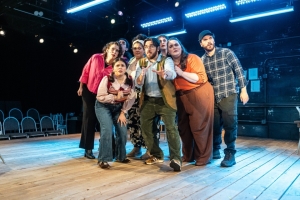
Dave Malloy’s Octet is a musical with daring aspirations, currently gracing the stage in a powerhouse co-production between the Raven Theatre and the Goodman Theatre. This staging, directed by Keira Fromm, first debuted at the intimate Raven Theatre, where it enjoyed a highly successful run before its move to the Goodman - a transition that proves the project is as robust as it is ambitious. Octet stands apart as a completely a cappella experience, relying entirely on the human voice to build its intricate, immersive, and haunting soundscape.
Malloy’s imprint is everywhere in this piece. He wrote the music, lyrics, book, and even the intricate vocal arrangements, crafting a score constructed without a single instrument to generate its tension, beauty, and emotional architecture.
Set in a sparse, church-basement style meeting room, the play introduces us to the “Friends of Saul,” a support group for people struggling with internet addiction. Their relationship to the online world is so fraught that they refuse to say its name, calling it only “the monster” to avoid giving it more power. Throughout their time together, the eight participants take turns sharing fears of being canceled, pornography, gaming, the pull of incel communities, and the inability to connect with others. Their discussions are brutally honest, darkly comedic, laced with expletives, and at one point offer an especially disturbing illustration of just how grotesque the monster can be. It’s unlike anything before.
The show threads each character’s intimate, emotionally charged account into sweeping ensemble passages that rise like contemporary hymns, the group joining voices to confront and grieve the “monster” that binds them. The interplay creates a pulse that feels communal and ritualistic, as though every personal admission is carried forward and reshaped by the collective.
The performances are nothing short of a whirlwind. The talent onstage is beyond belief. The ensemble showcases astonishing vocal mastery, blending with precision to create rich, enveloping music.
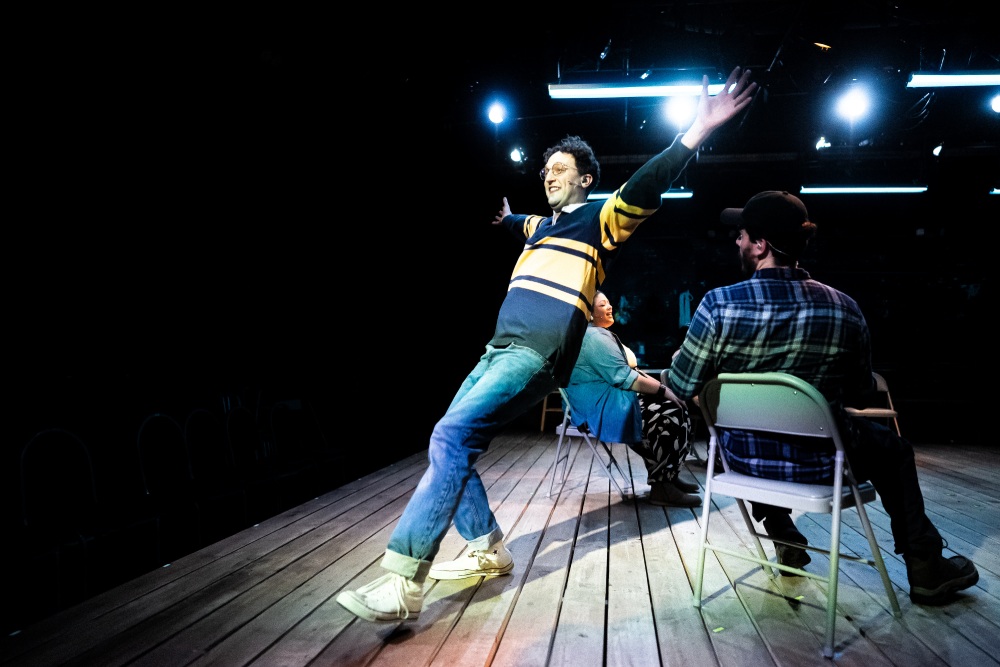
Sam Shankman in Dave Malloy's Octet at Goodman THeatre in collaboration with Raven Theatre. Photo by Joe Mazza.
Neala Barron, as Jessica, is phenomenal with powerhouse vocals and a dynamic stage presence. Her rendition of “Refresh” is delivered with the intensity of a tiger trapped in a cage, perfectly capturing the visceral feeling of being humiliated online and the subsequent rage against the world. Along with dramatic chops, she makes her comedic lines sizzle.
Sam Shankman plays the comedy perfectly as Henry. His portrayal of a tone-deaf, slightly dorky addict is both identifiable and deeply empathetic. His song “Candy” is a standout that demonstrates how this ensemble can craft story using only a cappella sound and how their movement reinforces the narrative.
Teressa La Gamba, as Paula, the group’s moderator, brings a gentle strength and compassion that helps root the show. But when she sings, it feels as if the roof will fly off. She commands the stage with perfect vocal precision, whether in a solo or complex ensemble passages.
The set is intentionally sparse and open, which functions perfectly for the show’s focused format, a choice scenic designer Milo Bue shapes with thoughtful restraint. The lighting design, crafted by Maximo Grano de Oro, is similarly impressive. Overhead lights shift deftly from the feel of a bland meeting room to the vibrant, chaotic interior of a Candy Crush interface or the dark corners of a character’s mind. In an instant, you can be transported to an entirely different plane and lost in its overwhelming atmosphere.
As the plot unravels, the staging seems intent on exploring where hope can or cannot be found, and it makes clear that faith-based religion is not where it looks. The script often approaches Christian belief with a skeptical edge, sketching certain “believer” archetypes in broad, unflattering strokes. The structure of “Friends of Saul” reinforces this orientation, lightly echoing the format of Alcoholics Anonymous. AA, one of the most widely recognized recovery communities, is often described as spiritual in nature, while many participants experience it as rooted in a faith-guided model, as it was originally intended. “Friends of Saul,” by contrast, operates with a more nonreligious bent, occasionally running out of pamphlets for “Steps for Agnostics and Atheists,” a detail made all the more ironic given that their meetings take place in a church basement - a space that pointedly distances itself from the faith‑oriented tradition AA is often associated with.
That contrast deepens in “Little God,” one of the staging’s more unusual songs. Here, Marvin (Jordan Golding), a committed atheist, describes an encounter with an all-powerful being represented onstage by a small girl and reflects on his compulsion to debate creationists about evolution. The moment is very much Malloy’s choice, framing Marvin’s fixation as a kind of intellectual loop: the irresistible pull of trying to reason through the idea that something as vast as existence might emerge from nothing at all, a purposeful artistic angle that shapes the show’s worldview.
Given these choices, the staging’s perspective may not resonate as strongly with audiences who hold traditional Christian views, which seems intentional, reflecting a deliberate direction in Malloy’s overall vision. In contrast, the show places greater emphasis on new age spirituality and tarot, treating these elements with notable sincerity. Each character has direct parallels to tarot cards, and Velma (Joryhebel Ginorio) finds her spiritual awakening through them. In fact, she is the only member of the group who speaks the monster’s true name, “internet,” throughout the night. Ultimately, the musical suggests that a blend of new age spirituality and human connection is the most viable path to inner peace.
Although these elements may pose challenges for certain audiences, Octet remains a triumph of vocal performance. These actors represent the highest caliber of Chicago talent, and when their voices come together, the result is breathtaking and inspiring. If you are looking for choral artistry, Octet delivers. For some audiences, Octet’s philosophical stance may feel more contemplative than corrective, raising more questions than answers about our relationship to the online world - but its musical brilliance makes the journey more than worthwhile.
Recommended.
Venue: The Goodman Theatre – The Owen 170 N. Dearborn Street, Chicago
Run Dates: Through August 2
Performance Schedule:
- Wednesdays: 7:30 p.m.
- Thursdays: 2:00 p.m. & 7:30 p.m. (No evening performance on July 30)
- Fridays: 7:30 p.m.
- Saturdays: 1:00 p.m. & 7:30 p.m.
- Sundays: 2:00 p.m. (Additional 7:30 p.m. performance on August 2)
Running Time: 1 hour, 35 minutes (no intermission)
Box Office: 312-443-3800
Tickets: https://www.goodmantheatre.org


Latest Articles
-
 Kokandy Productions Presents SUNDAY IN THE PARK WITH GEORGE - August 13 – November 1, 2026 at The Chopin Theatre
Written by Buzz Center StageFollowing its critically acclaimed productions of Sweeney Todd and Into the Woods, Kokandy Productions once again celebrates the great Stephen Sondheim with a revival of his stunning masterpiece Sunday in the Park with George, playing August 13 – November 1, 2026 in the intimate Chopin Downstairs Studio, 1543 W. Division St.…
Kokandy Productions Presents SUNDAY IN THE PARK WITH GEORGE - August 13 – November 1, 2026 at The Chopin Theatre
Written by Buzz Center StageFollowing its critically acclaimed productions of Sweeney Todd and Into the Woods, Kokandy Productions once again celebrates the great Stephen Sondheim with a revival of his stunning masterpiece Sunday in the Park with George, playing August 13 – November 1, 2026 in the intimate Chopin Downstairs Studio, 1543 W. Division St.… -
Steppenwolf Theatre Names Stage Manager Laura D. Glenn Newest Ensemble Member
Written by Buzz Center StageSteppenwolf Theatre Company Artistic Directors Glenn Davis and Audrey Francis are thrilled to welcome veteran Production Stage Manager Laura D. Glenn into the company's world-renowned ensemble. Glenn, whose journey with Steppenwolf began as a summer intern in 1988, has worked on more than 100 Steppenwolf productions over…
-
The Lizard y El Sol Returns to Chicago Parks Through August 9th
Written by Buzz Center StageThe whole family can enjoy The Lizard y El Sol, returning by popular demand to 12 public spaces citywide this summer. Co-Directors Jamal Howard (Splish Splash: A Day on the Lake) and Raquel Torre (BOOK UP!) again take the reins of this beloved "Theater for…
-
Chicago Tap Theatre Founder, Mark Yonally, Receives HOOFER AWARD from AMERICAN TAP DANCE FOUNDATION
Written by Buzz Center StageChicago Tap Theatre (CTT) is proud to announce its Founder and Artistic Director Mark Yonally has been selected by the Preservation Committee for the American Tap Dance Foundation to receive the 2026 Hoofer Award. Yonally will accept the honor at the Tap City Awards, Friday, Sept. 11 at…
Does your theatre company want to connect with Buzz Center Stage or would you like to reach out and say "hello"? Message us through facebook or shoot us an email at This email address is being protected from spambots. You need JavaScript enabled to view it..
*This disclaimer informs readers that the views, thoughts, and opinions expressed in the text belong solely to the author, and not necessarily to Buzz Center Stage. Buzz Center Stage is a non-profit, volunteer-based platform that enables, and encourages, staff members to post their own honest thoughts on a particular production.