
Displaying items by tag: Sarah Bockel
The Best of Us: Marriott Theatre’s Come From Away
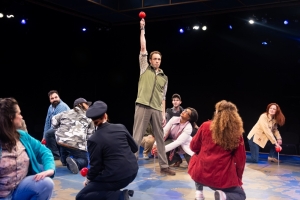
Come From Away begins from a place of deep uncertainty, yet what emerges is a story grounded in the steady, everyday kindness people offer when they have nothing else to give. Rather than revisiting the events of September 11 themselves, the musical focuses on the human responses that rose in their wake - small gestures that became anchors for thousands of strangers. Currently running at Marriott Theatre, this production leans into that humanity, reminding us that even in moments defined by fear, communities can reveal their best selves and set the stage for the remarkable true story that follows.
The origins of Come From Away trace back to the ten-year reunion of Gander residents and the airline passengers who found themselves unexpectedly grounded there during the September 11, 2001 airspace shutdown. Writers Irene Sankoff and David Hein attended that gathering, listening as people shared memories of fear, generosity, and the strange intimacy of those five days. Those first-hand accounts became the foundation of their musical, built from interviews, lived experiences, and the community’s own reflections.
Come From Away tells the remarkable true story of how the residents of Gander, Newfoundland opened their town to nearly 7,000 stranded passengers, transforming crisis into connection. Sankoff and Hein’s folk-infused score and ensemble-driven storytelling capture both the urgency of the moment and the warmth that defined the community’s response. Through intersecting vignettes - a pilot grappling with the weight of the tragedy, a couple who unexpectedly find love, and townspeople mobilizing with astonishing kindness as they scramble to meet the needs of thousands - the musical builds a fast-moving, emotionally resonant tapestry of resilience. The many moments are uniquely moving. One storyline follows a gay couple who initially fear they may have been displaced into a community that would not welcome them, only to discover that Gander’s embrace is far more open-hearted than they ever expected. Another centers on a mother whose son is a New York City firefighter, her fear deepening with every hour she goes without word of his safety. A further scene reveals how fear and uncertainty led to an instance of racial bias toward a Middle Eastern passenger, underscoring the tension and misunderstanding that shaped those early hours. It is also notable how long it took many of the stranded passengers to even learn why they had been grounded, completely unaware of the September 11 attacks unfolding beyond the airport tarmac.
One of the most striking things Come From Away made me realize is how little I had ever considered the logistics of suddenly hosting 7,000 unexpected guests. Lodging is the obvious hurdle, but the production makes you think about everything else: baby formula and diapers for stranded families, toothpaste and toilet paper for thousands of people who never planned to stay overnight, the sheer volume of food, toiletries, and basic supplies required to keep an entire town functioning under extraordinary circumstances. It is the kind of practical, human detail that rarely crosses your mind until a musical places it right in front of you. And right in the middle of all that panic and uncertainty, one passenger quietly quotes Philippians 4:6 — “Be anxious for nothing.” The moment lands with such gentle force that it clearly holds the audience, as if the reassurance reaches beyond the stage.
The ensemble works together with the fluid precision Come From Away is known for, but a few roles naturally carry more emotional weight. Beverly, played by Lexie Dorsett Sharp, provides one of the show’s strongest through lines, her reflections as a pilot adding quiet depth to the production. Claude, portrayed by Alex Goodrich, anchors the local perspective with a steady, good-humored presence as Gander’s mayor who so wonderfully inspires the townsfolk, while Hannah, brought to life by Sharriese Hamilton, is a deeply felt presence as the firefighter’s mother. Around them, the rest of the company contribute vivid moments that round out the tapestry of stories, each adding texture without overshadowing the show’s ensemble spirit.
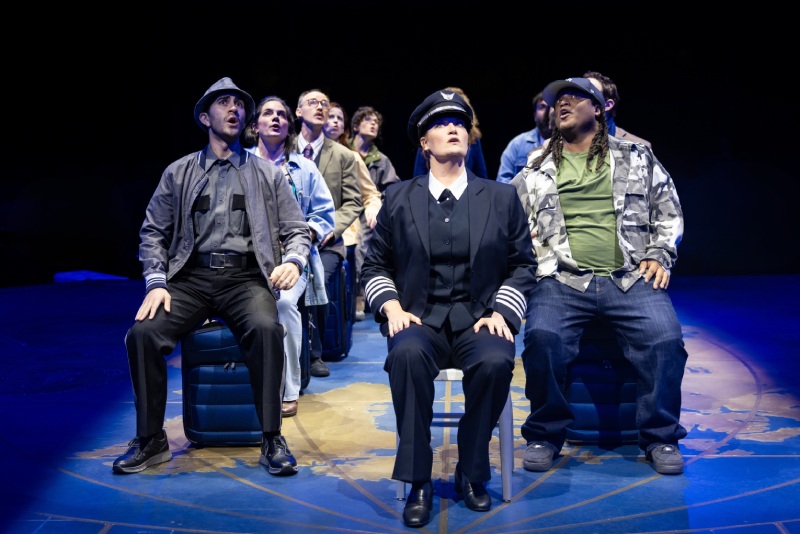
Lexie Dorsett Sharp and cast in Marriott's Come From Away. Photo by Justin Barbin.
The cast also gets a welcome lift from its other strong players, each actor shifting cleanly through multiple roles with the precision the show demands. Justin Albinder, in particular, delivers sharply timed, very funny moments that consistently land. Alongside him, Matt Crowle, Devin DeSantis, Denise Devlin, Sarah Bockel, Madison Kauffman, Heidi Kettenring, Michael Earvin Martin, and Jonathan Shaboo contribute to a unified, well-calibrated company whose collective work feels much larger than the sum of its parts.
Marriott’s production benefits from clear, confident leadership behind the scenes. Jessica Fisch’s direction keeps the ensemble moving with purpose, shaping the intersecting stories with a calm, assured touch that lets the emotional beats land without force. Katie Spelman’s choreography adds subtle lift to the staging - never flashy, but always intentional - helping the momentum build in ways that feel organic to the storytelling. Scenic designer Scott Penner and lighting designer Jesse Klug further elevate the production, using Marriott’s in‑the‑round configuration and luggage that doubles as plane seats to create the illusion of a bustling, overcrowded environment despite a cast of just twelve. Through razor‑sharp transitions, fluid movement, and smart spatial design, the stage often feels packed with 40 or 50 people, turning simplicity into spectacle without ever losing intimacy.
The musical’s score finds some of its strongest moments in a handful of standout numbers. “Me and the Sky,” led by Lexie Dorsett Sharp, remains the show’s defining emotional peak, her performance giving the song a grounded clarity that resonates long after it ends. Ensemble pieces like “Blankets and Bedding” and “28 Hours / Wherever We Are” showcase the cast’s cohesion, capturing both the frantic energy of Gander’s rapid mobilization and the passengers’ first fragile steps toward connection. Alex Goodrich brings an easy charm to “Screech In,” turning the raucous drinking ritual into one of the evening’s most crowd-pleasing scenes. And in “I Am Here,” Sharriese Hamilton delivers a quiet, concentrated punch, shaping one of the musical’s most affecting solo moments. The musical lift throughout is supported by conductor Celia Villacres and music coordinator Trevor Jones, whose work keeps the score driving, unified, and emotionally sharp. In these moments, the score shows its full range, moving easily between lightness, tension, and heartfelt storytelling.
What surprised me most was how deftly the musical balances somberness with humor. Given the weight of September 11th (now approaching its 25th anniversary), I expected the tone to stay anchored in grief, but Come From Away keeps finding pockets of levity, warmth, and genuine laughter. The humor never undercuts the tragedy; instead, it highlights the resilience and humanity that emerged in the midst of fear. The show moves back and forth between emotional registers with such ease that you are never left in one feeling for too long, making the experience unexpectedly uplifting.
Marriott Theatre’s production of Come From Away offers a thoughtfully crafted, emotionally grounded evening that earns its place among the company’s stronger musical offerings. The ensemble’s cohesion, the clarity of its overall arc, and the steady warmth woven throughout make this a production well worth seeing.
Highly Recommended.
Runs through October 18th at Marriott Theatre in Lincolnshire.
One hour and forty‑five minutes with no intermission.
Tickets and additional information: www.marriotttheatre.com/show/come-from-away
Review: 'Falsettos' at Court Theatre

Even 40 years later, the AIDS crisis continues to shape American life. Long before Hollywood brought AIDS stories to the cultural mainstream, the theatre was a safe place for actors and writers to explore their fears and sense of injustice for a mass audience.
‘Falsettos’ playwright William Finn began working on what would become the now classic musical in the 1970s, as a response to the gay liberation movement. The play started as a series of one-acts concerning Marvin, the show’s protagonist as he navigates leaving his family for his male lover. Initially the first installment, ‘In Trousers’ was a critical and commercial failure. Finn considered abandoning theatre entirely, but instead collaborated with lyricist James Lapine to create ‘Falsettos’. A musical that would explore both gay liberation and the early years of the AIDS epidemic through the vantage point of Finn’s character Marvin.
Court Theatre and TimeLine Theatre team up for a joint revival of ‘Falsettos’ at the Hyde Park theater. With a 70s-themed set, audiences are transported back to 1979 where they meet Marvin, the play’s central character played by Steven Schellhardt. Not only is this a play about gay culture, but it’s also a celebration of the Jewish-American experience. The show begins with a song ‘Four Jews in a Room Bitching’ that introduces the sing-songy musical style that permeates throughout.
Marvin is leaving his wife Trina (Sarah Bockel) for his new lover Whizzer (Jack Ball). Trina is taking up with the family psychiatrist Mendel (Jackson Evans). Their son Jason (Charlie Long) is caught in the middle as his parents duke it over his approaching bar mitzvah. Marvin wants it all, his perfect nuclear family and his new lover, at whatever emotional cost that comes to his son, his lover and Trina. What’s so striking about the first act is how modern the themes are. Perhaps in a world without the specter of AIDS hanging over it, this odd family arrangement would have eventually worked itself out. Act I essentially lives in a vacuum uninfluenced by the coming epidemic. Act II catches up with the characters two years later. Things have slightly improved for Marvin and his family but another grim reality emerges. Whizzer becomes one of the AIDS epidemic’s first victims. This 11’o clock tone shift admittedly feels jarring especially against the chipper upbeat music. Though, it makes this musical feel unique as far as AIDS literature goes. It’s not the AIDS musical per se, but rather a musical about the gay experience that features AIDS. In this story, the virus is so new it doesn’t even have a name or a course of treatment.
Lyricist James Lapine crafted words for Sondheim classics like ‘Sunday in the Park with George’ and ‘Into the Woods’. His signature rhyming scheme are both a blessing and a curse for ‘Falsettos’. Sarah Bockel is undeniably this production’s strongest asset, especially during numbers like ‘Trina’s Song’ showcase her talent as a singer and physical performer. However, the lyrics feel outdated as any sort of feminist anthem.
The play is aptly titled ‘Falsettos’ as the characters are often singing in a much more upbeat style than the content of the lyrics. Sometimes it works, and sometimes the rhyming feels like a reach. The musical style works well in big cast numbers like ‘Falsettoland/It’s About Time’, but when the play takes on a more serious tone the format feels contradictory to the plot.
Director Nick Bowling and music director Otto Vogel present a faithful, high-end revival that will delight fans of the musical. The cast rises to the occasion wonderfully, especially child actor Charlie Long as the hopelessly awkward teen caught in the middle of his parents’ drama. Putting ‘Falsettos’ into the context of today’s more accepting world, it feels like a victory lap, a reminder of how far society has come. It’s a celebration of love in all its forms.
Through December 8 at Court Theatre. 5535 S Ellis Ave. 773-753-4472.
Beautiful: The Story of a Natural Woman

While I’d yet to see Beautiful: The Carole King Musical since it premiered to much acclaim (and a U.S. tour) a couple years ago, I entered the Cadillac Palace Theatre for its latest Chicago debut a lifelong Carole King fanboy. I knew her songs. I knew her story. But for a couple hours on Wednesday night, the cast of this latest touring production made me feel like I knew her.
But first, those songs. The audience, young and old, knew them all. The older ones, the ones who’d been there the first time around, giggled with nostalgia. And the rest of us – who know them from parents, from oldies radio, from YouTube, from simply being alive – were every bit as thrilled. From John Michael Dias’ mugging Neil Sedaka singing “Oh Carol” on national TV to his former high school flame, Carole Klein, to the ensemble’s medley of Brill Building tunes love-potioning and splish-splashing and yakkity-yakking, we were all Boomer kids taken back to a not-simpler time.
The real standouts of this jukebox time machine were two vocal quartets. Playing the parts of The Shirelles, Little Eva and her backing singers, and Janelle Woods and her own group, McKynleigh Alden Abraham, Traci Elaine Lee, Marla Louissaint, and Alexis Tidwell were magic as they brought classic takes on King’s “Will You Love Me Tomorrow” and “One Fine Day.” The dresses, the elegant moves, the wedding chapel harmonies, and those songs. Wow. They were only equaled by their male counterparts – Josh Dawson, Jay McKenzie, Avery Smith, and Kristopher Stanley Ward – whose coiffed hairdos, satin suits, and smooth moves as The Drifters made it look so easy as they doo-wopped and stepped to “Some Kind of Wonderful” and “Up on the Roof.” But Ms. King’s songs weren’t the only ones on display. While The Drifters did a nifty walk down Weil and Mann’s “On Broadway,” the rival songwriting duo’s “You’ve Lost That Lovin’ Feeling” was retaken from Tom Cruise’s boozy Top Gun barroom ballad by Matt Faucher and Dias again as The Righteous Brothers. Faucher’s baritone filled the Cadillac, and Dias’ high harmonies brought it home. Again, wow. Wish I’d been there the first time around, but this cast showed off their chops while paying quite a tribute to the classic songs and their songwriters who the story’s about.
And about that story. Again, as a fan, I knew the outline: NYC kids slave away in a Times Square hit-making sweatshop, soundtrack a generation, and one of them makes it big herself later on. But the main cast fleshed out the story’s characters. They took them from characters to people. James Clow’s gum-chewing, contract-signing Don Kushner was intimidating but encouraging. Sarah Goecke’s witty, Cole-Porter-wannabe wordsmith, Cynthia Weil, was a woman ahead of her time. Jacob Heimer’s neurotic lady’s man, Barry Mann, made you root for him. And Andrew Brewer’s smoldering but sensitive Gerry Goffin made you swoon, even as you knew the dirty dog was sneaking around on his Carole.
And Carole. Oh, Carole. As Neil Sedaka sang, “there will never be another.” And throughout the show, lead Sarah Bockel not only proved Sedaka right, giving us Carole King’s look and playing and voice, she gave us Carole Klein, the person. Many talented performers could probably approximate King’s hair or her vocals. But Bockel went beyond that, giving us the perky and precocious 16-year-old writing those hits and falling for that hunk. She gave us the broken but devoted young mother finding out not just who she’s married to – Bockel and Brewer’s chemistry was very sweet and seemed very real – but who she herself is. And she gave us that self, finally confident to write her own words, to tell her own story, to sing it loud, for a crowd, for us. And that story, of a woman claiming her soul from the lost and found and using it to give voice to not just a generation, but many generations to come, was what wowed the Cadillac’s crowd the most. The voices will make you applaud. The songs will make you nostalgic. But the story this cast and their show tell of this natural woman, this national treasure, will make you feel. It made me feel.
For more show information visit www.broadwayinchicago.com.




Latest Articles
-
 City Lit announces August Wilson's KING HEDLEY II October 16 through November 29 - here the cast
Written by Buzz Center StageFull cast and production team have been announced for City Lit's production of August Wilson's KING HEDLEY II, to play from Friday, October 16 through Sunday, November 29. KING HEDLEY II is set in the same backyard in Pittsburgh's Hill…
City Lit announces August Wilson's KING HEDLEY II October 16 through November 29 - here the cast
Written by Buzz Center StageFull cast and production team have been announced for City Lit's production of August Wilson's KING HEDLEY II, to play from Friday, October 16 through Sunday, November 29. KING HEDLEY II is set in the same backyard in Pittsburgh's Hill… -
 Standing Room Only Crowd for Chicago’s Leading Theater Artistic Directors
Written by Bill EslerIt must have been heavenly for the creative leaders of Goodman, Steppenwolf, Chicago Shakespeare and Court, Chicago’s top regional theaters, to be greeted by a standing room only crowd. But there they were, on a panel moderated by the eminent…
Standing Room Only Crowd for Chicago’s Leading Theater Artistic Directors
Written by Bill EslerIt must have been heavenly for the creative leaders of Goodman, Steppenwolf, Chicago Shakespeare and Court, Chicago’s top regional theaters, to be greeted by a standing room only crowd. But there they were, on a panel moderated by the eminent… -
 The Best of Us: Marriott Theatre’s Come From Away
Written by Kimberly KatzCome From Away begins from a place of deep uncertainty, yet what emerges is a story grounded in the steady, everyday kindness people offer when they have nothing else to give. Rather than revisiting the events of September 11 themselves,…
The Best of Us: Marriott Theatre’s Come From Away
Written by Kimberly KatzCome From Away begins from a place of deep uncertainty, yet what emerges is a story grounded in the steady, everyday kindness people offer when they have nothing else to give. Rather than revisiting the events of September 11 themselves,… -
Steppenwolf Theatre Presents Revival of TOPDOG/UNDERDOG September 17 – November 1 / Rehearsals Underway
Written by Buzz Center StageSteppenwolf Theatre Company, the nation's premier ensemble theater company, is pleased to launch its 51st Season with Suzan-Lori Parks' Pulitzer Prize-winning drama Topdog/Underdog, helmed by Tony Award-winning director Kenny Leon, who returns to Steppenwolf following his hit production of King James. Ensemble members Glenn Davis (Windfall, Purpose–Chicago/Broadway, King James) and Namir Smallwood (Windfall, The Book of…


Does your theatre company want to connect with Buzz Center Stage or would you like to reach out and say "hello"? Message us through facebook or shoot us an email at This email address is being protected from spambots. You need JavaScript enabled to view it..
*This disclaimer informs readers that the views, thoughts, and opinions expressed in the text belong solely to the author, and not necessarily to Buzz Center Stage. Buzz Center Stage is a non-profit, volunteer-based platform that enables, and encourages, staff members to post their own honest thoughts on a particular production.