
Displaying items by tag: Paul Oakley Stovall
Now Boarding: Bonnie’s Last Flight, a Sky‑High Comedy with Real Heart
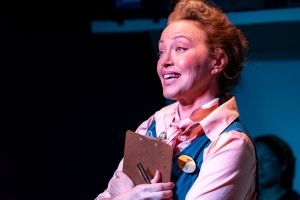
Rivendell Theatre Ensemble closes its milestone 30th season with Bonnie’s Last Flight, a sly, sky‑high comedy set during a flight attendant’s final day on the job - a blend of sharp satire and warm, traditional character comedy that’s genuinely, disarmingly funny. Jan has always carried a quiet love for writing, and now she’s earned a spot in an elite program - a dream she’s never fully allowed herself to chase. Handing over her wings means more than leaving the airline; it means finally giving herself permission to focus, to create, and to figure out who she is when she’s no longer defined by the job that shaped her life. But instead of treating her retirement as a tidy celebration, the play leans into the strange limbo that comes when a long‑held identity is about to disappear. Jan isn’t just stepping off a plane - she’s stepping out of the role that has shaped her routines, her friendships, and the way she moves through the world. That kind of transition can feel exhilarating, but it can also feel like freefall: What happens when the structure you’ve relied on for decades suddenly dissolves? Who are you when the uniform comes off?
Around her, the cabin is filled with a wonderfully mismatched crew navigating their own turbulence. Greig, her closest colleague - and one of the few people Jan truly considers family - is somehow the only person on board who doesn’t realize this is her final flight. While Jan quietly braces for the unknown, Greig clings to nostalgia – reminiscing about the 70s and 80s when people flew with style and grace, which in turn translated to proper behavior as passengers. LeeAnne, the rookie attendant, is still wobbling her way through the basics and is convinced the rest of the crew resents her simply for being young. Meanwhile, the Captain - who relies a little too heavily on mid‑air “comforts” - and the Co‑Pilot form an offbeat duo doing their best to keep the ride smooth and the mood light, even as everything around them threatens to veer off course. And then there’s Mark Twain – Jan’s guiding light and inspiration - drifting through the cabin like a sardonic travel spirit, adding an off‑kilter, almost dreamlike layer to the already unpredictable atmosphere. At any given moment, he might toss out a Twain‑ish zinger like, “Don’t argue with stupid people - they’ll drag you down to their level and beat you with experience.”
And yes - the title Bonnie’s Last Flight does mean something specific. The play waits to share it, and it’s worth letting that moment land on its own.
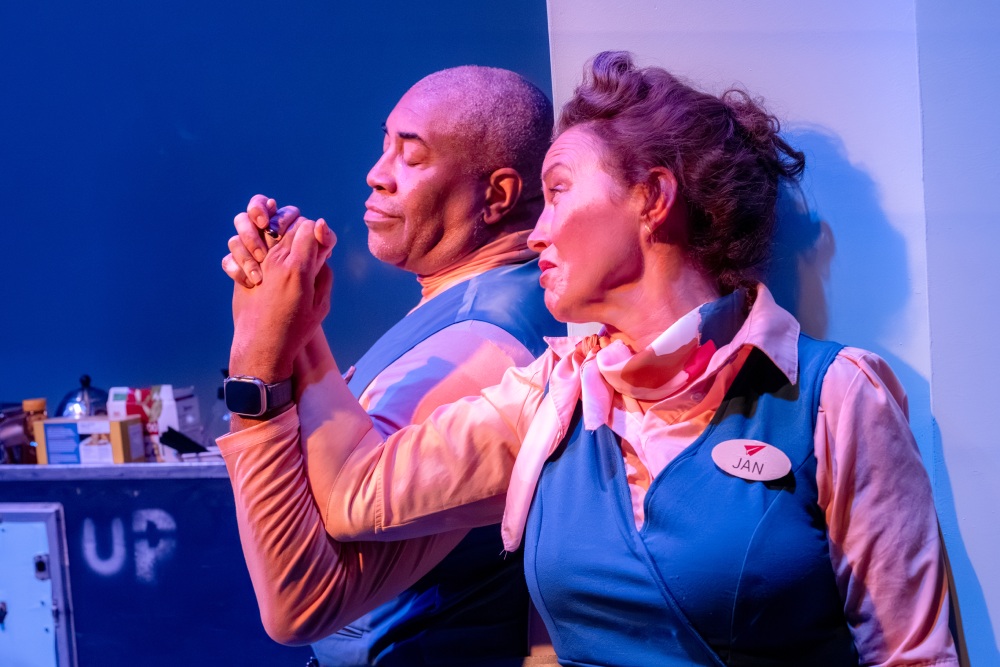
Paul Oakley Stovall as Greig and Rebecca Spence as Jan. Photos by Jenn Udoni.
Rivendell’s latest offering finds sharp, playful humor in every recognizable quirk of air travel - from the ritual of cramming bags into overhead bins to the exaggerated seatbelt pantomime, from the sad little routines of in‑flight food service to the collective sigh of a delayed takeoff, and even the inevitable moment when the Boingo internet keeps going down. Playwright Eliza Bent (The Regulars, Karen, I Said) threads these details together with wit and oddball charm - comic gold, really - especially in the way she captures the crew’s half‑coded, half‑conspiratorial communication style. Director Devon de Mayo amplifies that energy by staging the entire piece as an 85‑minute real‑time passage through the air on the gloriously scrappy Smelta Airlines, traveling from “use your imagination” to Chicago. Audience members are assigned boarding groups before entering, and once inside, the immersion never breaks - we are the passengers, and the cast treats us as such. In Rivendell’s intimate 40–50 seat house, the action unfolds close enough to feel immediate, with scenes playing out just a few feet away and often surrounding you entirely. Surprise song‑and‑dance numbers erupt out of nowhere and are executed with precision that feels almost impossible in such close quarters. As someone who now dreads flying, I thoroughly enjoyed being on this airborne adventure.
On top of the cleverly crafted script and fine‑tuned direction, the cast’s blend of Rivendell regulars with notable newcomers is the last flourish that makes the whole thing take off. Rebecca Spence, a longtime Rivendell ensemble member fresh off her appearance in Chicago Shakespeare Theater’s Fault directed by Jason Alexander and her screen work on Taylor Sheridan’s The Madison, returns with a commanding presence as Jan, grounding the production with a performance that moves effortlessly between wry humor and quiet emotional depth. Up close, we see what a truly talented actor she is - we feel every beat of her internal calculus, the uncertainty, the flickers of excitement, the moments of reflection, and even the disappointments, all delivered with a subtlety that makes her journey resonate long after the plane arrives in Chicago.

Eric Slater (left) as Pilot and Glenn Obrero as Co-Pilot in Bonnie's Last Flight.
Spence is joined by fellow Rivendell ensemble members Jessica Ervin, Eric Slater, and Glenn Obrero, each bringing sharp timing, confident comic instincts, and just the right touch of vulnerability when the moment calls for it, with Paul Oakley Stovall and LaKecia Harris rounding out the cast as fantastic additions who elevate the ensemble’s already cohesive dynamic.
Eric Slater’s dry‑witted Captain/Pilot lands every beat with understated precision, while Jessica Ervin’s off‑balance LeeAnne provides a wonderfully unpredictable charge that never feels forced. Glenn Obrero’s earnest Co‑Pilot (“Jesus,” as the Captain likes to refer to him), brings a lovable silliness along with genuine warmth, a combination that gives the show extra bounce. Paul Oakley Stovall, a standout as Greig, draws on his wide‑ranging stage experience to deliver a performance full of nuance, comic assurance, and centered emotional presence that adds unexpected depth to the production. The ensemble’s cohesion is further strengthened by LaKecia Harris, whose turn as Mark Twain brings a sly, confident rhythm that meshes seamlessly with the group’s comic fabric. Together, they’re dynamite - fully in tune with one another and performing with the cohesion of a team that’s been flying together for years.
At its core, Bonnie’s Last Flight is less about airline chaos and more about the uneasy moment when a person realizes the next chapter of life doesn’t come with a boarding pass. Jan is standing at the edge of retirement, a place where excitement and dread blur together. Leaving a long‑standing job can feel like stepping off a moving walkway: suddenly the rhythm that shaped your days disappears, and you’re left wondering who you are without the role that once defined you. While Jan wrestles with that quiet panic, the rest of the cabin spirals in their own directions - LeeAnne dodging emotional landmines, the Captain leaning too hard on liquid courage, and Erik trying to squeeze a thought into the noise. Beneath the jokes and mishaps, the play nudges at something more human: the fear of losing purpose, the hope of reinvention, and the strange freedom that comes when life forces you to start over.
This design team gives us the feel of being inside an airplane, creating an environment that gently echoes the experience of settling into a cabin. Scenic designer Regina García shapes Rivendell’s intimate space into a compact aircraft interior, complete with a cockpit, a small lavatory, a food‑and‑drink station, and lighted walkways that recall the soft glow of aisle markers guiding passengers to their seats. Saawan Tiwari’s costumes reinforce the world with grounded, character‑specific details that nod to real airline crews without slipping into caricature. Garnett Bell’s lighting adds subtle shifts that mirror the ambience of a cruising cabin or the quick changes that accompany an announcement. And Satya Chavez’s sound design supplies the familiar chimes, the pressurized hush of doors, and the clipped rhythm of airline instructions, creating an auditory landscape that instantly situates us in the sky.
In short: Bonnie’s Last Flight promises a strange, playful, and slightly chaotic airborne adventure - a character‑driven comedy about people stuck in the sky and stuck in their lives, trying to figure out what comes next. The humor lands repeatedly with precision, but what ultimately gives the show its staying power is the heart that surfaces beneath and during the laughs - those small, sincere moments of connection and longing that linger long after the final descent.
Already extended to October 25th at Rivendell’s home on Ridge Avenue, this production is a sure‑fire good time that’s sure to send you back to the friendly skies with a smile. For tickets and more show info, visit https://www.rivendelltheatre.org/bonnieslastflight.
Highly recommended.
Merry Mischief in Windsor: Chicago Shakespeare’s Fast, Funny Triumph

Shakespeare’s comedies share a familiar architecture: mistaken identity, disguises, intersecting plotlines, a generous helping of prose, and language that delights in wordplay and double entendre. They are also, crucially, driven by sharp, intelligent women who often see more clearly than the men around them. With that foundation in mind, Chicago Shakespeare Theater’s production of The Merry Wives of Windsor leans confidently into these conventions - and then accelerates them - resulting in a delightfully mischievous evening.
Directed with precision and pace by Phillip Breen, the production wastes no time settling in. It moves briskly, almost breathlessly at times. Breen understands that comedy, especially Shakespearean comedy, thrives on rhythm. Doors must slam at just the right moment, disguises must be revealed a beat too late, and jokes must land before the audience has time to anticipate them. Here, the timing is razor-sharp, aided immeasurably by a cast of 22 actors who navigate the text with clarity and ease.
Max Jones’ set design cleverly situates Windsor in a contemporary world of affluence and quiet excess. This is a town where privilege is not just visible - it is assumed. Children attend private school, men play rugby, and women occupy a social sphere of lunches and shopping that doubles as a kind of informal power network. The Garter Inn, rendered as a dimly lit bar with a billiards table anchoring the space, becomes a playground for Falstaff’s schemes. In contrast, Dr. Caius’ sterile office reception area offers a clinical absurdity, while the Ford household gleams with white carpeting, glass, and sweeping staircases - its opulence undercut by the chaos unfolding within. A particularly fluid set change transforms the space with near-magic, reinforcing the play’s obsession with illusion and transformation. The final forest scene, textured with dirt mounds and trees, grounds the production just enough before it tips fully into theatrical fantasy.
What emerges most clearly in this production is the idea that Windsor is a world turned slightly askew. No one is quite what they claim to be. The knight, Sir John Falstaff, is anything but noble - he is vain, opportunistic, and gloriously ridiculous. The doctor, Caius, is less healer than hot-headed rival, perpetually threatening violence. The clergyman’s thick accent renders him a subject of humor rather than authority. Even the Justice of the Peace seems more eager for confrontation than civility. It is a community in which status is worn like a costume—and just as easily discarded.

Photo by Kyle Flubacker.
At the center of it all are the “merry wives,” who prove themselves to be the most grounded and perceptive figures on stage. Ora Jones’ Mistress Page and Issy Van Randwyck’s Mistress Ford anchor the production with wit and composure. They are never merely reactive; they orchestrate the action, turning Falstaff’s attempted manipulation into a series of escalating humiliations. Their intelligence drives the comedy, ensuring that the laughter always has a point of view.
The supporting cast is equally strong. Chike Johnson’s Master Page exudes an easy confidence, while Timothy Edward Kane’s Master Ford leans fully into the character’s jealousy, finding both humor and unease in his suspicion. Nate Burger’s Dr. Caius is a comic standout, his bluster and indignation landing with delightful force. Nancy Voigts brings a bustling energy to Mistress Quickly, threading together the play’s many schemes, while Paul Oakley Stovall’s Justice Shallow captures the absurdity of self-importance.
And then there is Jason Simon’s Falstaff - a performance that embraces the character’s excess without apology. Legend has it that Queen Elizabeth I so adored Falstaff that she demanded to see him in love. Here, however, Falstaff is in love with nothing so much as himself. Simon leans into that vanity, crafting a figure who is both despicable and irresistibly watchable. His repeated downfalls never diminish him; instead, they reveal the elasticity of his ego.
Ultimately, this production succeeds because it trusts the mechanics of Shakespearean comedy while fully committing to its world. Disguises are embraced, identities are blurred, and language sparkles with innuendo. Yet beneath the laughter lies a sharper observation: that power, status, and even identity itself are often performances. In Windsor, everyone is playing a role - some just play it better than others.
Highly Recommended
When: Through May 3
Where: Chicago Shakespeare Theater 800 East Grand Avenue in Chicago
Tickets: $60 - $120
Box Office: 312-595-5600
Info: www.chicagoshakes.com
This review is proudly shared with our friends at www.TheatreInChicago.com.
Review: Gods & Monsters at Theatre Wit

“James was deeply aware of the anguish associated with denying others their authenticity; His famous Frankenstein wasn’t a murderous monster. His heart’s desire was friendship cleverly bestowed upon him by a blind man”. Norm Woodel
Frame of Reference Productions In Association with The Woodel Inspiration Fund has embarked on a daring and poignant new stage adaptation of "Gods & Monsters," based on Christopher Bram's 1995 novel "Father of Frankenstein" and its acclaimed 1998 screen version. This production, under the innovative direction of Paul Oakley Stovall and the creative script by Tom Mullen, brings to life the fictionalized final days of James Whale with a fresh perspective and a profound exploration of identity, empathy, and the human condition.
Scott Westerman as James Whale delivers a masterful performance, capturing the complexity of a man whose health and career are in decline, yet whose spirit remains fiercely alive. Westerman’s portrayal is both haunting and tender, embodying Whale’s struggles with mortality and his reflections on a life marked by both brilliance and tragedy. His nuanced performance allows the audience to feel Whale’s pain, his moments of joy, and his gradual descent into the depths of mental decline.
Rashun Carter as Clayton Boone is a revelation. In a bold move, Boone is reimagined as a Black man, a decision inspired by Whale’s own casting of Black activist Paul Robeson in "Show Boat." Carter, who I recently saw in “Judy's Life's World” brings depth and sensitivity to Boone, portraying him as more than just a muse or object of affection; he is a fully realized character whose presence challenges and ultimately changes Whale. The chemistry between Westerman and Carter is palpable, their interactions charged with warmth and a delicate balance of power and vulnerability.
Doreen Calderon as Maria Ramirez, Whale’s housekeeper, provides a compelling performance that adds another layer of richness to the narrative. Calderon’s Maria is both protective and candid, her Mexican heritage bringing a new dimension to the story. This character’s evolution reflects the broader themes of race and empathy that Mullen seeks to explore. Calderon’s ability to convey strength and warmth in her role makes her a standout in the cast.
Ethan Check as Edmund Key and Michael Stejskal as David Lewis offer strong supporting performances, each bringing their unique dynamics into Whale’s world. Check’s Edmund Key, a figure from Whale’s past, and Stejskal’s David Lewis, Whale’s loyal companion, both serve as crucial elements in understanding the protagonist’s internal and external conflicts.
The decision to center the theme of race in this adaptation is executed with sensitivity and insight. Mullen’s script honors Bram’s original work while introducing contemporary resonances that feel both timely and timeless. The narrative weaves together the personal and the political, showcasing how Whale’s identity and experiences shaped his empathy for the marginalized—a trait that is evident in his cinematic masterpieces.
Paul Oakley Stovall’s direction ensures that the story remains intimate and character-driven, even as it tackles broad societal issues. Stovall’s understanding of the material’s emotional core allows for moments of genuine connection and introspection. His approach, combined with Mullen’s articulate script, brings out the universal themes of loneliness, aging, and the desire for intimacy in the face of repressed desires and past traumas.
Most of the action unfolds within the mind of James Whale, brought to life through the creative vision of set designer Ben Lipinski and the collaborative efforts of lighting and projections designer Mike Tataj. They seamlessly weave time and place together, creating a cohesive tapestry of scenes. The use of scrims with projected scenes pays homage to Whale’s legacy as a filmmaker. This production boasts the highest production values I have seen thus far this year.
In conclusion, "Gods & Monsters" is a triumph, primarily due to the compelling bond between Whale and Boone. This thoughtful, provocative, and deeply moving adaptation honors its source material while offering fresh insights. The powerful performances, meticulous direction, and insightful script coalesce to create a theater experience that resonates on multiple levels, emphasizing our shared humanity and the transformative power of empathy. This production not only tells the story of James Whale but also mirrors society, highlighting the ongoing struggles and triumphs of those who dare to be different, all through the lens of Whale and Boone's evolving friendship.
Highly Recommended
When: Through June 2
Where: Theatre Wit 1229 Belmont Avenue
Running time: 1 hour, 30 minutes
Tickets: $12.75 - $47.75 (student & senior tickets)





Latest Articles
-
 Detroit ’67: A Basement Becomes a City on the Brink
Written by Wesley DavidDetroit was burning in the summer of 1967, inside one basement, life was still going on. That contrast is at the heart of Dominique Morisseau’s Detroit ’67, now being produced by Pulse Theatre Company in residence at eta Creative Arts…
Detroit ’67: A Basement Becomes a City on the Brink
Written by Wesley DavidDetroit was burning in the summer of 1967, inside one basement, life was still going on. That contrast is at the heart of Dominique Morisseau’s Detroit ’67, now being produced by Pulse Theatre Company in residence at eta Creative Arts… -
 Now Boarding: Bonnie’s Last Flight, a Sky‑High Comedy with Real Heart
Written by Ken PayneRivendell Theatre Ensemble closes its milestone 30th season with Bonnie’s Last Flight, a sly, sky‑high comedy set during a flight attendant’s final day on the job - a blend of sharp satire and warm, traditional character comedy that’s genuinely, disarmingly…
Now Boarding: Bonnie’s Last Flight, a Sky‑High Comedy with Real Heart
Written by Ken PayneRivendell Theatre Ensemble closes its milestone 30th season with Bonnie’s Last Flight, a sly, sky‑high comedy set during a flight attendant’s final day on the job - a blend of sharp satire and warm, traditional character comedy that’s genuinely, disarmingly… -
Chicago Shakes' Play On!: With a Syncopated Harlem Beat
Written by Wesley DavidThere are some productions you watch, and then there are productions that make your heart swoon and your toe tap. Sheldon Epps’ Play On! is definitely the latter. Now playing at Chicago Shakespeare Theater, this exuberant musical takes Shakespeare’s Twelfth…
-
 Step Right Up and Ride the Cyclone (The Musical) at Metropolis Arlington Heights
Written by Anne RakowieckiIf anyone has ever told you to buckle up and enjoy the ride, they were talking about life—and even if they didn’t know it, they were talking about Ride the Cyclone, the musical. When six teenagers die in a rollercoaster…
Step Right Up and Ride the Cyclone (The Musical) at Metropolis Arlington Heights
Written by Anne RakowieckiIf anyone has ever told you to buckle up and enjoy the ride, they were talking about life—and even if they didn’t know it, they were talking about Ride the Cyclone, the musical. When six teenagers die in a rollercoaster…


Does your theatre company want to connect with Buzz Center Stage or would you like to reach out and say "hello"? Message us through facebook or shoot us an email at This email address is being protected from spambots. You need JavaScript enabled to view it..
*This disclaimer informs readers that the views, thoughts, and opinions expressed in the text belong solely to the author, and not necessarily to Buzz Center Stage. Buzz Center Stage is a non-profit, volunteer-based platform that enables, and encourages, staff members to post their own honest thoughts on a particular production.