
Displaying items by tag: Ian Barford
Tom Stoppard’s epic finale Leopoldstadt is an instant classic at Writers Theatre
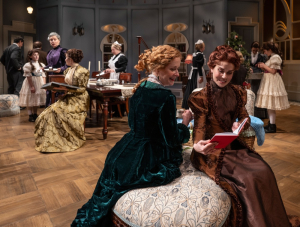
What would you do if you found out your heritage wasn’t what you thought it was? In Tom Stoppard’s case, he wrote a sweeping, epic play about it. Glencoe’s Writers Theatre brings Leopoldstadt to the Chicago area for the first time since its West End and Broadway runs in the early 2020s. Directed by Carey Perloff, a longtime friend and collaborator of Stoppard’s, this final stage play proves to be among his best.
Stoppard passed away late last year but he left a decades-long cannon of seminal stage and screenplays. When his semi-autobiographical play “Leopoldstadt” began performances in the West End in early 2020, he was sure it would be his last. Though he wrote it in a year, it took nearly 30 years to find the narrative. Stoppard, who was raised as a gentile most of his life, was told by a family member in 1993 he was of Jewish heritage and that many of his family members were murdered in the Holocaust. Stoppard escaped Czechoslovakia as a child and was raised in the UK entirely unaware.
A blended Jewish-Catholic family’s history in 20th century Vienna is divided neatly into four pivotal scenes with a sizeable cast of some of Chicago’s best. In the first scene, a Christmas party (1900), we’re shown a Vienna in which Jews were considered equals. Families had interfaith marriages and shared holiday celebrations. By the second scene (1924), WWI has redrawn the maps of Europe. Austria, as well as the family, finds itself in a precarious place. Scene three (1938) portrays an Austria fully committed to the Third Reich and family alliances are put to the test when the family is forced out of their home by the Nazis. The final scene (1955) happens in the aftermath of Austria’s reunification following WWII. This last scene mirrors Stoppard’s own life and serves as an emotional climax to a play that is often dense with political and historical theory.
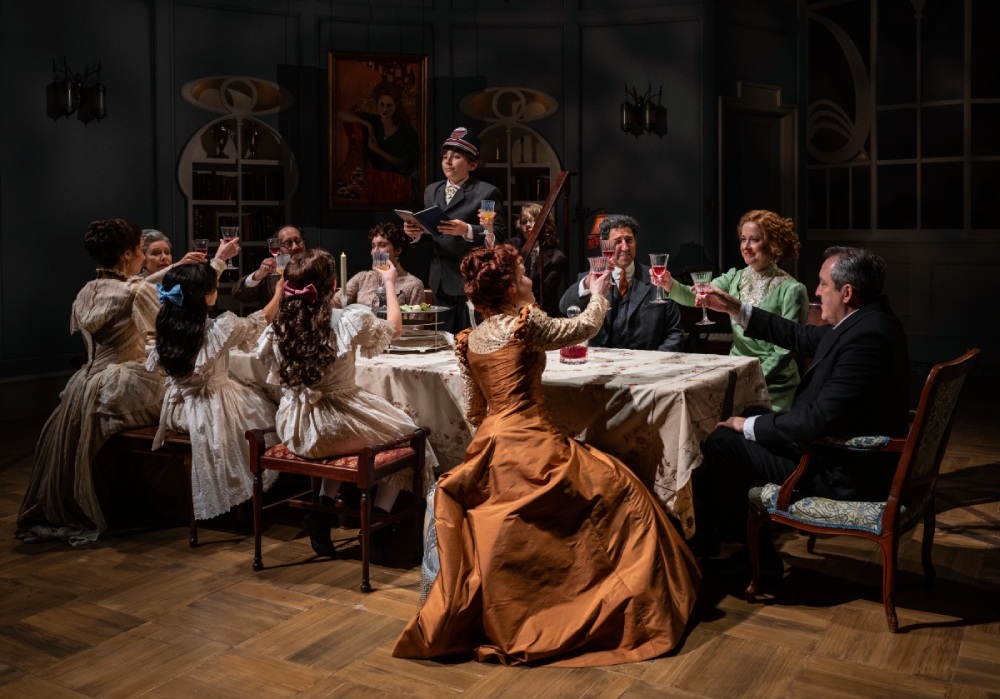
The cast of Leopoldstadt. Photo by Michael Brosilow.
Writers Theatre’s production is as faithful to the original as you can get. Carey Perloff directed the Boston and D.C. premieres too. Along with an all-star cast of Chicago heavy hitters, Perloff’s production will likely be remembered as the definitive Midwestern revival. Between Ken MacDonald’s set and Alex Jeager’s costumes, audiences are sure to be swept away to a different time and place that can feel eerily reminiscent to the present.
As the eras change so do the actors playing the characters. Stoppard’s script trusts that the storytelling is so engaging that audiences will figure out who’s who by the context clues, and he was right. Some may find the story hard to follow but thankfully a helpful lobby installation catches everyone up on the history of Austria during this time period.
Writers Theatre favorite Kate Fry plays a Catholic woman, Gretl, who marries into a prominent Jewish family. Her performance is at first charming but by the end heartbreaking. Jessie Fischer delivers a transformative performance, particularly during the final scene. Rounding out the male ensemble is Ian Barford as Hermann who plays a converted catholic, but it’s his deterioration that is unforgettable. Justin Albinder is given the meatiest part of the final scene and his ability to switch from one emotion to the next is some of the most natural acting of the evening.
Leopoldstadt is every bit as epic as something like Gone with the Wind. Much like the famed novel and movie, this play tells the story of a civilization, a family, lost to the tragedy of war. It’s a story of a family’s near extinction. Stoppard’s brilliance is on full display and how lucky are we to have this capstone for his illustrious career?
Through August 16 at Writers Theatre. 325 Tudor Ct, Glencoe, IL. 847-242-6000
https://www.writerstheatre.org/events/leopoldstadt
This review is proudly shared with our friends at www.TheatreInChicago.com.
Review: Amadeus at Steppenwolf Theatre

Safe to say Steppenwolf’s revival of Peter Shaffer’s Amadeus is “fetes and fireworks”. Robert Falls makes his directorial debut at Steppenwolf after recently retiring from his role as Goodman Theatre artistic director. To say his new production of Amadeus makes a splash would be an understatement. Falls brings his signature vision to the still new in-the-round stage at Steppenwolf for a thrilling evening of theatre.
Even in the so-called peak of Broadway attendance, very few straight plays ran for three months let alone three years. Amadeus opened on Broadway in 1980 starring Ian McKellen, Jane Seymour and Tim Curry (as Mozart) where it ran for three years. It went on to win several Tonys and was eventually adapted into an Academy Award winning film in 1984. Since plays don’t last long on Broadway, it begs the question: what about Peter Schaffer’s play resonated with audiences? The film has also attracted a considerable cult following.
Pete Shaffer uses the rivalry between Italian composer Antonio Salieri and young Mozart as an allegory for professional jealousy and intergenerational conflict. The dastardly Salieri is played by Steppenwolf ensemble member Ian Barford while his counterpart is played by David Darrow. Though Shaffer admits to inventing many of the details of his play, his version turns the music world of 1700s Europe into a kind of rock ‘n roll. When we think of the classic composers, we think of them as we think of their music–mild, inoffensive, something to put on in the background to get work done. Amadeus portrays Mozart as an enfant terrible: a womanizer and drunkard. His wild lifestyle is likely what led to his most important operas, even if they were mostly lighthearted comedies. Shaffer makes classical music cool by bending the lore to fit his own artistic agenda.

David Darrow, Jaye Ladymore and ensemble member Ian Barford in Steppenwolf Theatre Company’s production of Amadeus.
Robert Falls’ revival feels as fresh as when it opened over 40 years ago. While the movie is known for lavish sets and costumes, Steppenwolf’s production is somewhat modest. Minimalism only adds to the cool factor here. One of Falls’ innumerable talents as a director is creating visual splendor. Together with longtime scenic collaborator Todd Rosenthal, Falls’ shows audiences countless moments of theatrical magic. Steppenwolf’s choice to present this play in the round is a wise one that affords the cast an opportunity to move in and around the audience.
Falls has gathered a wonderful cast. While the headliner here is Mozart, the real star of the show is Salieri. The villain begins the show as the main character and in his lengthy confession we see he is more often the tormented one even though he’s in the position of power. Barford’s performance is less delicate than how this part has traditionally been approached. His hulking figure in period dress only adds to his threatening persona that feels more masculine than intellectual. Darrow on the other hand plays the clown well in the first act but leaves audiences devastated by the conclusion. His indefatigable energy is a lot of fun to watch.
Steppenwolf’s Amadeus is as exciting as the news that Robert Falls switched houses to direct it. In many ways it feels way less stuffy than some of his most impressive work at Goodman. Though this production is basically perfect, there’s a bit of grit left on it and it’s all the better for it.
*Extended through January 25th



Latest Articles
-
 “A Strange Loop” Lets the Intrusive Thoughts Win at Raven Theatre in partnership with About Face Theatre
Written by John AccroccoA musical, but it’s just the voices in your head. Sounds just crazy enough to win the 2020 Pulitzer for Drama. “A Strange Loop” by Michael R. Jackson finally makes its Chicago premiere at Raven Theatre in a co-production with…
“A Strange Loop” Lets the Intrusive Thoughts Win at Raven Theatre in partnership with About Face Theatre
Written by John AccroccoA musical, but it’s just the voices in your head. Sounds just crazy enough to win the 2020 Pulitzer for Drama. “A Strange Loop” by Michael R. Jackson finally makes its Chicago premiere at Raven Theatre in a co-production with… -
 Announcing Goodman's 22nd New Stages 2026 Festival Line-Up
Written by Buzz Center StageFrom a "Kung Fu rom-com" to a witchy new musical, The Goodman's popular New Stages Festival in its 22nd year continues to offer a first glimpse at the latest works by a handful of the hottest contemporary playwrights. This year's four-play…
Announcing Goodman's 22nd New Stages 2026 Festival Line-Up
Written by Buzz Center StageFrom a "Kung Fu rom-com" to a witchy new musical, The Goodman's popular New Stages Festival in its 22nd year continues to offer a first glimpse at the latest works by a handful of the hottest contemporary playwrights. This year's four-play… -
URBANTHEATER COMPANY ANNOUNCES THE LATINA POWER FALL SERIES
Written by Buzz Center StagePuerto Rico es una Cama Twin by Ana Sophia Colón and Black Latina (The Play) by Crystal Roman run October 9 through 18 on Paseo Boricua, with pay-what-you-can tickets from $15 and Friday morning matinees for Chicago schools CHICAGO, IL…
-
Chicago Danztheatre Ensemble Announces 2026-2027 Season
Written by Buzz Center StageChicago Danztheatre Ensemble (CDE) is pleased to announce its 2026 - 2027 season. CDE will open this artistic season with Copestic Vibrations: A Music Festival, Friday, Nov. 13 and Saturday, Nov. 14, followed by a fully staged production of For…
Does your theatre company want to connect with Buzz Center Stage or would you like to reach out and say "hello"? Message us through facebook or shoot us an email at This email address is being protected from spambots. You need JavaScript enabled to view it..
*This disclaimer informs readers that the views, thoughts, and opinions expressed in the text belong solely to the author, and not necessarily to Buzz Center Stage. Buzz Center Stage is a non-profit, volunteer-based platform that enables, and encourages, staff members to post their own honest thoughts on a particular production.