
Displaying items by tag: Harris Theater
Chicago Black Dance Legacy Project Gala: Radiant & Sumptuous at the Harris
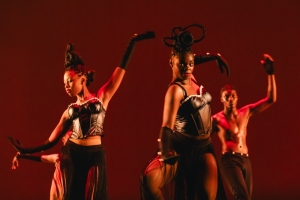
The first thing you notice about the meticulously curated Black dance performance held at the Harris Theater over the weekend is language. The eloquence and weight of the words used to explain why the Chicago Black Dance Legacy Project (CBDLP) exists and what it hopes to achieve.
Organized in 2019, Black dance companies rooted in Chicago joined forces to learn from one another artistically and operationally while working in collaboration with the Reva and David Logan Center for the Arts in Hyde Park and “other University of Chicago entities”. Sustaining viability and preserving legacy were placed at the heart of the project’s end objectives.
Its formation would have several residual benefits. An annual festival of dance performed by the companies who make up CBDLP remains chief among them. Events like the one held Friday night to a sold-out house also raise the profile of Black dance in Chicago and underscore its contributions to the city’s cultural topography and its continuing vitality.
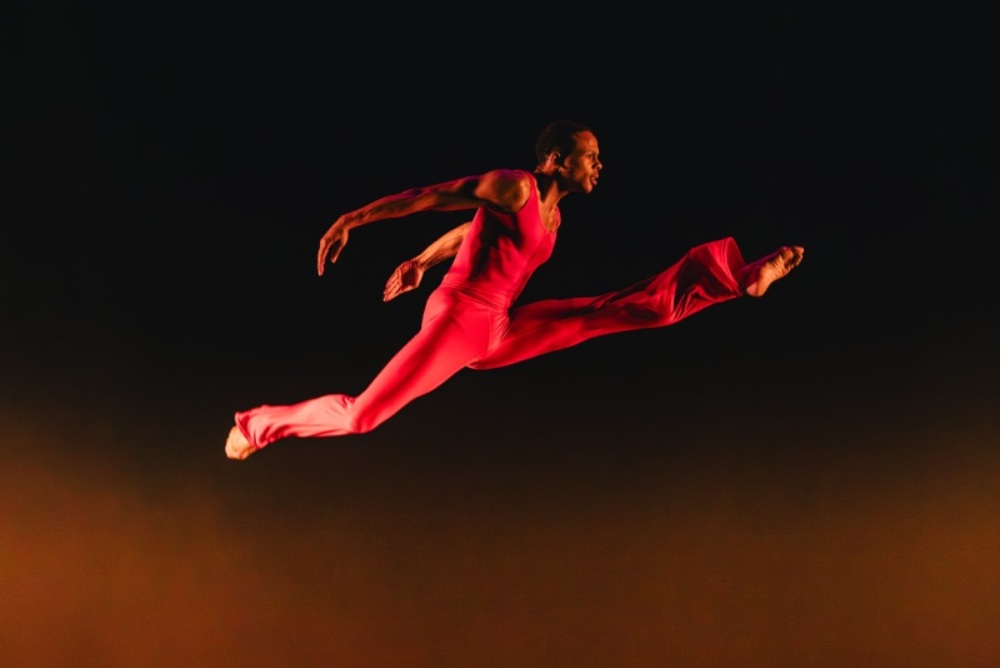
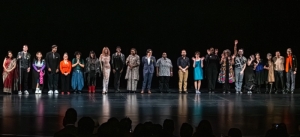
Dancing the Archive: Embodied Histories, Collective Power / Photos by Kyle Flubacker.
Honoring and showcasing the history and the arc of Black dance sat at the core of Dancing the Archive: Embodied Histories, Collective Power, the title of the evening’s multi-textured production. Not only was it dense with dance featured by ten of the project’s cohort companies, video clips that provided essential context on the trailblazers who spearheaded creative renewal within the Black creative community was also woven through this remarkable gala. The clips also helped to convey the importance and significance of the works being performed. Framed as chapters in a book, the dances flowed together to tell a comprehensive story.
Made up of 175 companies, dance culture in Chicago is extraordinarily deep, wide and rich. For Black companies who often face greater exposure challenges, Dancing the Archive serves to train the spotlight on their presence and gifts. The high degree of that talent and its proliferation marked the entire program that opened with a focus on youth.
Each individual work or dance suite performed honored a key individual who is making or has made significant contributions to Black dance or some other aspect of the city’s cultural art forms that reflect the Black experience. Through The Stillness celebrated Homer Bryant, founder of the Chicago Multi-Cultural Dance Center. A work that Mr. Bryant choreographed and performed here by members of his company, it used Albinoni’s Adagio for Organ and Strings to pay homage to concentrated sensuousness. A dance for two performed by Sasha Levy and Davion Bellinger, it was an accomplished composition of strength, control and technical mastery executed with extreme beauty by two young dancers.
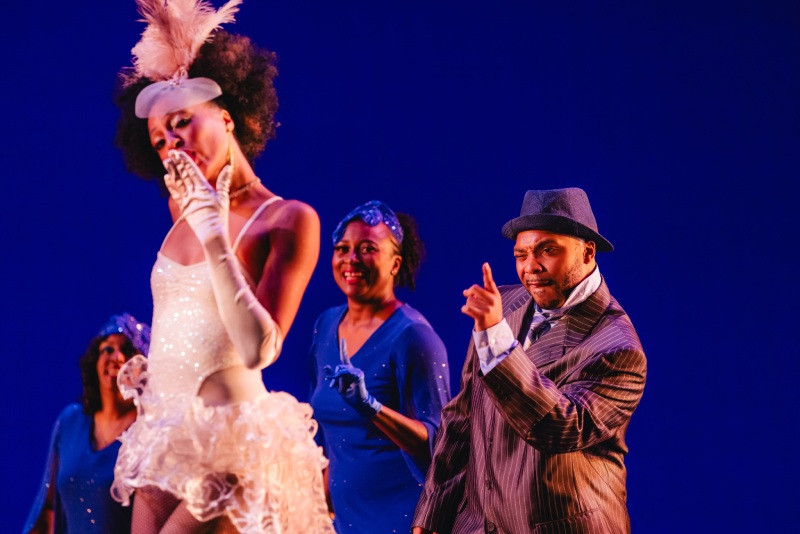
Dancing the Archive: Embodied Histories, Collective Power
The first chapter’s companion piece, Touch U, was a world premiere and an adaptation of Gerald Arpino’s Touch Me. In it, choreographers Bradlee Lathon and Pierre Lockett collaborated with a phalanx of their very youthful and talent-laden dancers at Forward Momentum Chicago to present a dance sparkling with infectious positivity. Bursting with innovative and highly sophisticated contemporary dance design, Touch U felt as if you were watching the next generation of dance on a maiden voyage. One that couldn’t have been more stimulating or aesthetically refreshing.
That sense of captivating vibrancy defined Dancing the Archives. In addition to the absorbing heritage-centered components of the program, dance was used to provide visual markers to history and highlight the place Black dance held during its march. Najwa Dance Corps’ Ancestral Steps looked back to dance crazes 100 years ago in the mid 1920s when the Charleston electrified a generation and the music of Count Basie ruled the airwaves. Later, in another world premiere, M.A.D.D. Rhythms with their Oscar Plays Gershwin Suite (They All Laughed, Summertime, Nice Work If You Can Get It), deftly exalted the “fire, finesse and swing” of tap with cool bravado.
The span of time and of dance expressions that paralleled it was vast. Muntu Dance Theatre of Chicago in Woven jubilantly recalled another time and place when “living archives” were embodied in a central griot-like figure.
Lines in Motion danced by The Era Footwork Collective was all about the kind of suavity that happens when you fuse mellow chill to dazzling footwork; creating repeated flashes of dance lightning in the process.
With Chance the Rapper as honoree, Chicago Multicultural Dance Center and Hiplet Ballerinas placed an impish toe in the future with its playfully eerie Speed of Light; attaching culturally specific overtones to our tech laden times.
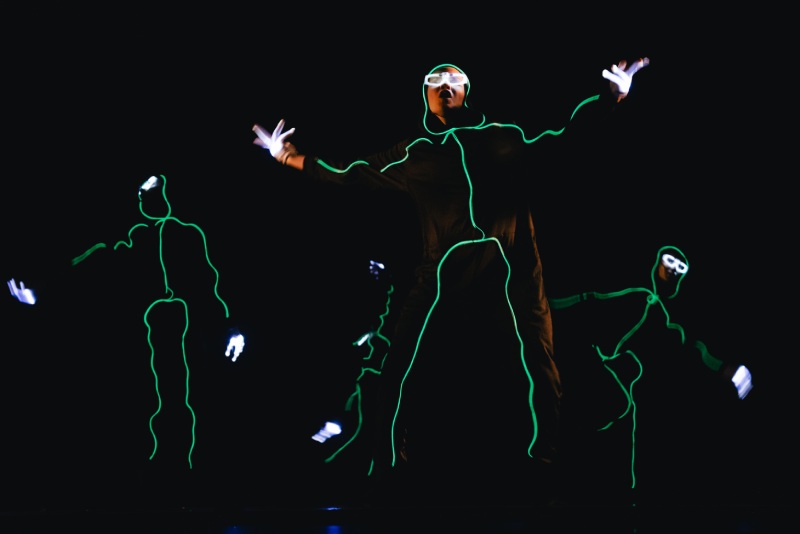
Dancing the Archive: Embodied Histories, Collective Power
Superlatives in either concept, execution or; most commonly, both ran thick in many of the other dances performed. Most of which have never been seen by audiences until now. Dorianne Thomas’s solo in Who Will Comfort Me, a world premier for the record books by the Joel Hall Dancers, was flawless in her display of dance fluency and emotional projection through movement. Attributes found in other performances were just as noteworthy. Praize Productions Inc.’s Leader of the Pack and Deeply Rooted Dance Theater’s excerpt from Crowns instantly come to mind. As does that churning and jubilant tribute to Curtis Mayfield and Lupe Fiasco by Move Me Soul. Curtis Suite and Sour, masterminded by Diana Muhammed, brought back to life the musical catalog of a genius and created a dance piece that complemented it gorgeously.
Because remembrance played such a significant role in the program, the In Memoriam segment commemorating leaders and standard bearers who died in 2025 was particularly notable and memorable. Before presenting the names and images of the fallen, a solo rendition of Precious Lord was sung by Cholé Johnson. Distinguished by its spare simplicity and for Ms. Johnson’s captivating interpretation, the artistic merits of the performance were astonishingly high. The song’s inclusion fittingly reveals the thread of the divine that lies within so much Black creative enterprise. An indispensable component often found in the bedrock of creative inspiration.
Dancing the Archive: Embodied Histories, Collective Power
Chicago Black Dance Legacy Project
August 28, 2026
The Harris Theater for Music and Dance
205 E. Randolph Street
Chicago, IL 60601
For more information: https://www.chicagoblackdancelegacy.org/
3Arts Awards Celebration uplifts Illinois' artistic community, Oct 26 at Harris Theater
The nonprofit service organization 3Arts announces the date for its annual 3Arts Awards Celebration, a festive evening of dynamic performances by Chicago artists and the announcement of the recipients of unrestricted grants to artists working in the performing, teaching, and visual arts. The 2026 3Arts Awards Celebration takes place at the Harris Theater for Music and Dance (205 E Randolph) on Monday, October 26, at 5:30pm. Tickets for the event, which includes a welcome reception, awards program, and a jubilant after-party, are $150 (general admission) and $300 (VIP) with a limited number of $50 tickets available for industry professionals. Tickets will be available at 3arts.org/tickets in early September. Funds raised during the event will be split between 3Arts and Chicago nonprofit, Center for Native Futures.
"When artists rise, communities rise with them,” says Cat Tager, Executive Director of 3Arts. "Because art isn't a luxury; it's a foundation of any thriving community. As we head into our 20th year in 2027, we are looking forward to celebrating the milestone of putting $10 million directly into the hands of Chicago artists, and to continuing our mission to provide the critical programming that helps those artists to experiment, to take risks, and to elevate our communities.”
Thirty-six artists will be honored at this year’s program, which distributes unrestricted awards across three categories: the 3Arts Awards ($30,000 each), Next Level Awards ($50,000 each), and the peer-selected Make a Wave Awards ($2,000 each). The celebratory evening will also feature powerful performances by three past 3Arts awardees.
Expanded for 2026, the Next Level Awards will now include two awards in Music and two in Theater, made possible by support from the Paul Angell Foundation. This marks the first time these unrestricted grants will be available to musicians and theater artists, following the initiative's initial launch in Visual Arts (2020) and subsequent expansion into Teaching Arts.
3Arts has distributed more than $10 million in grants to more than 3,050 artists since 2007. 3Arts awardees reflect 66% women artists, 74% artists of color, and 17% Deaf or disabled artists.
2026 3Arts Awards Celebration
Dates: Monday, October 26, 2026
5:30pm Welcome Reception
6:30pm Awards Celebration and Performances
7:45pm After Party
Location: Harris Theater for Music and Dance
205 East Randolph Drive
Tickets: Tickets are $50-$300 and can be purchased in early September at 3arts.org/tickets and via the Harris Theater Box Office at 312.334.7777.
About 3Arts
Founded in 1912 with a history centered on women artists and reimagined as an arts service organization in 2007, 3Arts supports artists in the Chicago metropolitan and greater Carbondale areas working in the performing, teaching, and visual arts, including women-identified artists, artists of color, and Deaf and disabled artists. The 3Arts Awards were launched in 2007 to provide unrestricted awards, project funding, residencies, professional development opportunities, and promotion to help artists take creative risks, build sustainable careers, and contribute to the cultural vitality of Chicago and the broader region.
3Arts extends special thanks to the 2026 Award Partners: The HMS Fund, The SIF Fund at the Chicago Community Foundation, Stan Lipkin & Evelyn Appell Lipkin, and MSU Federal Credit Union.
One of the ten 3Arts Awards, the 2026 3Arts/MSUFCU Community Award celebrates the collective generosity of artists and supporters across Chicago, whose contributions made the award possible.
3Arts also recognizes support for the Next Level Awards from an anonymous donor at The Chicago Community Foundation, the Paul Angell Foundation, and the John D. and Catherine T. MacArthur Foundation.
For more information about 3Arts, please visit www.3arts.org.
Brodsky/Baryshnikov at Harris theater: Poetry in Motion in the Truest Sense

In association with the Harris Theater for Music and Dance, The Cherry Orchard Festival, a leading presenter of international artists, theater companies and orchestras, presented the Chicago premiere of “Brodsky/Baryshnikov,” this past weekend. Chicago is one of three limited engagements of this production, including stops in Boston and Toronto earlier this year. This New Riga Theater and Baryshnikov Productions co-produced this piece, based on the poems of Russian Nobel Laureate Joseph Brodsky, which is performed in Russian by accomplished dancer and performer Mikael Baryshnikov. Inspired by the poetry of his long-time friend and with encouragement of director Alvis Hermanis, this entrancing play made its premier at the New Riga Theater, in Latvia on October 15th, 2010 and began its North American debut in 2016. We count ourselves lucky in Chicago, that the intimate setting of the Harris Theater is where “Brodsky/Baryshnikov” decided to make its premiere.
Commanding the stage against the backdrop of a moonlit sky and the haunting stillness of crickets in a still night (Jim Wilson’s “God’s Chorus of Crickets”), Baryshnikov enters through the rear doors of a train station vestibule. He is dressed in a dark suit, brown shoes and carrying a blue briefcase this character that enters the stage is a weary traveler, awaiting a slow arriving train. Emptying a few of the contents in his bag, he prepares for his next leg of travel with an alarm clock, books of poetry and a bottle of Jameson.
Maybe it is the solitary sense of the character, alone at the station, or the eerie stillness of the night. The haunting stillness continues to entrance you as Baryshnikov begins to mumble and whisper some of the poetry he is reading aloud. In this very personal interpretation of what can only be described as, an understanding of art and artist, could only have been done by a true friend. And it is done in a truly captivating fashion, even for those who don’t speak Russian. As the English translations scroll across the awning of the train station, it almost seems unnecessary to focus your attention entirely on the poetry, as he expresses himself with interpretive dance, subtle facial nuances, and Japanese kabuki style movements. As Baryshnikov speaks, his voice washes over the once chatty and unsettled crowd, which has drawn them into silence to witness this internal conversation of men discussing life, aging, death, change and one’s own fatality amongst the flutter of butterfly wings, the ripples of water or the cries of one’s struggles. Nothing more so, emphasizes this exchange than about thirty minutes into the show when Baryshnikov begins to recite Brodsky’s poem “May 24, 1980” — a poem written on his fortieth birthday; the radio on the opposite bench starts to play. Brodsky’s voice fills the theater, overtaking that of Baryshnikov’s. It’s a somber reunion, to hear the voice of Brodsky reciting his poetry.
The effect this conversation has on friends is eloquent and thought provoking. The images that Baryshnikov portrays defy the image we have of him, revealing a man of seventy-years-old. However, the control of his performance, the beauty in his grace, and the feeling emanating from each movement, has the audience reveling in the depth of the poetic arrangements and the emotions they evoke with such intensity that the audience leaves in quiet murmurs – we leave with pensive faces and contemplative stares. This moving performance is one, not to miss, but to experience.
Brian Brooks on Hubbard Street's Fall Series

Harris Theater's first ever Choreographer in Residence, Brian Brooks, is ready to make his mark in Chicago. “It’s not just what I might be bringing to the Harris theater, but what Chicago is showing me and being exposed to all of these new dancers and choreographers.”
Brooks residency at the Harris is set last for three years, and so far, collaborations planned include the Miami City Ballet and Brooks own dance group, Brian Brooks Moving Co. Each piece commissioned will be performed at the Harris Theater. “The potential for artistic growth is very liberating. This particular structure of this residency, working with very different and diverse companies, the Hubbard Street versatility and contemporary work that they do, my own company that gets quite adventurous with athletic physicality and pre avante garde original music compositions, and then Miami City Ballet, the classical ballet, and where they want to head in this new era. The range of dancers and aesthetics that his residency is encouraging me to work with, it’s a huge step and a platform I am very honored to be a part of.”
In Hubbard Street Dances Fall Series, Brooks premiered his first work, Terrain and if this is any indication of what is to come the next three years, Chicago is in for a treat.
Terrain certainly lives up to Brooks description. With 17 Hubbard Street Dancers taking the stage “I’m playing a bit with imagery, all of the dancers are integrated with a call and response and cause an effect. Every dancer is navigating in their cave of space in relation of the group” There is constant movement, one dancer always reacting to another’s movement or touch. As if energy is being passed through them, the performance is bright and energetic.
Throughout the piece, the dancers are continuously coming together and moving apart. Brooks says, “The piece is slightly an abstraction, the dancers work as individuals and a community, it has overtones of simple and community integration, using the rapid response and quick fire partnering creating a moment to moment imagery.”
Terrain is an exciting and spirited piece from this Chicago newcomer. Chicago should keep their eye on Brooks as he is sure to bring some fresh perspective and inventive collaborations to the Harris Theater over the next three years.
The Art of Falling: An Amazing Collaboration of Dance and Comedy

Some things were just meant to go together, even if they do sound a little odd at first. Like peanut butter and bananas, apple pie and cheddar cheese, Lady Gaga and Tony Bennet; The Art of Falling is amazing collaboration between Hubbard Street Dance Chicago and The Second City. The unexpected pairing of the extremely original and unique contemporary dance company, and a Chicago improve comedy standard, both staples of Chicago entertainment in their own right, was a match made in theater heaven!
Hubbard Street Dance has done many interesting collaborations in the past, pushing the envelope of what a dance performance is and exposing new audiences to dance in creative ways. In 2014, Hubbard Street and Second City first got together and put together the energetic, unexpected and endlessly engaging performance entitled The Art of Falling. Now back at the Harris Theater by popular demand, the show is once again bringing laughter, joy and maybe even some tears to Chicago audiences.
This distinctive show incorporates so much more than simply dance and comedy. They leverage video - both pre-recorded and live footage, audience interaction, endless props and fantastic music – again both live and recorded. The sheer creativity of this production is mind-blowing. There are 20 pieces that make up this show, each different from the one before but just like a great comedy show, it circles around a primary story line and a few smaller secondary ones, making the whole show flow together seamlessly and move along effortlessly.
The primary story line is a love story of course, but it challenges the traditional silver screen romance as it is rooted in real life where relationships are bumpy and have awkward edges that need smoothing and love - or rather admitting you are in love - is scary. It challenges the audience to take that leap of faith and conquer the fear of falling. After all, what is the worst that can happen?
All of the performers, under the direction of Billy Bungeroth, were pure perfection and there certainly were a lot of them! This collaboration was made up of five choreographers, three writers, six actors and two dozen dancers. At times, it was difficult to tell the comedians from the dancers as each tried on the others role with dancers delivering well timed punch lines and comedians flexing their dancing muscles. The writing was witty and fun, and the choreography was exceptional, highlighting the extreme talents of the dance company as well as their humorous side. In a piece completely improved by both the comedians and the dancers, it draws some unexpected similarities between the art of improv comedy and improv dance.
Part of the appeal of this performance is that it continually surprises the audience with more and more creative, imaginative and inventive pieces. After the first act when you think they cannot top themselves, they prove you wrong with a second act that just keeps on impressing. All of that said, I leave this review here so as to not ruin the magic for you. You have to see this show for yourself. As it wows the audience with its cleverness, it also touches the heart and inspires the audience to take just let go, and not be afraid of falling.
Be sure to get your tickets now and catch The Art of Falling at the Harris Theater through June 19th!
Trip the Light Fantastic: A Modern Dance Super Hero Saga

Have you ever wondered what would happen if a group of washed up superheroes decided to put their powers to use in a new way – a non-profit organization dedicated to helping the world in a slightly less fantastic way? And, what if they were modern dancers? Well so did Julia Rhoads, the artistic director of Lucky Plush Productions (LPP). Along with her ensemble cast, they combine dance, theater, comic book style video graphics and tons of creativity to tell us the story of seven oddball super heroes, with powers ranging from audio control to lactation, who are working with a marketing company to define the brand and mission statement for their do-gooder non-profit organization. In each of their working sessions, they open with an invocation of the space, go on a training mission and complete individual introductions, each time getting closer to a purpose and forming as a team.
LPP strives to create works that are both dynamic and complex, as well as accessible to a wide audience. Both of those were achieved in this show and despite some slow moments, it was overall an enjoyable twist on a modern dance performance. In all of their works, LPP focuses on experiences that can be shared in the moment between the audience and the performers. In this performance, all of the dancers/actors are mic-ed and as they dance, they also chat with each other or add in the unexpected element of singing, having the effect of bringing the audience into the performance and making it feel more casual – as if they audience were sitting in on the sessions. By breaking down the wall between the performers and the audience, and introducing breaks in the dancing for theatrical moments, it allows the audience to feel more connected to the story and the characters, something often challenging for audience members who are new to the modern dance scene.
The choreography was expressive, moving and energetic. As each character introduces themselves, the choreography style changes to match their personality and super power. All of the styles merged into one representing the strength of the group as they combined forces by the end of the show. The entire ensemble brought vibrant energy to the dancing. The performances of Michel Rodriguez Cintra and Benjamin Holliday Wardell stood out the most. Michel, whose character acquired the powers of the frog after ingesting a frog smoothie, seemed to spring off the floor with powerful and distinctive jumps. Michael is performing in his third season with LPP. Benjamin, a five-season LPP veteran, brought graceful and classical movement to his character inspired by beauty and art.
The theater element allowed them to make some clear and strong statements about environmentalism, racism, feminism and privilege, and also brought some lightheartedness and humor to the performance as well. As the crew went through session after session, the patterns became a bit repeatable which created moments that dragged due to predictability. On the upside, as they returned for each new session, their costumes evolved into more proper superhero costumes – starting out as basic t-shirts and pants and progressing to full outfits embellished to match their characters. It was a subtle but fun addition to the costuming for the show.
Bringing it all together was the clean and simple set design, comprised of 10 white square panels set up along the back of the stage. The bottom row of panels was on wheels and could be moved to accommodate the needs of the performance. Both live video and pre-arranged graphics were projected onto the screens throughout the show, bringing some excitement to an otherwise simple set. In the scene where we become introduced to Glitch, who has the power to control sound, the combination of perfectly coordinated video projections, sound and movement demonstrated the strong impact that can be achieved with all the elements working together.
Overall, the show was an imaginative combination of dance, theater and video that lowers the barrier for entry to modern dance. The story is clear and easy to follow; the dancing is clean, rich and artistic; the set design and costumes as well integrated into the overall show and it invites the audience in to the journey of the making of Super Strip!
Trip the Light Fantastic: The Making of Superstrip is being performed at the Harris Theater for Music and Dance. For more information visit www.LuckyPlush.com or www.HarrisTheaterChicago.org.
An Evening of Work by William Forsythe Moves with the Audience with Accuracy and Danger

In the first piece titled, "N.N.N.N.", in the Hubbard Street Dance Chicago Fall Series at Harris Theatre, two men and two women dance in silence except for the occasional sounds of their breath and grunts of exertion, which are both a relief to hear and even comical in places. Forsythe seems to have derived an entirely new alphabet of modern dance for this piece! Although the simple movements, a hand placed on one shoulder, a clap, or a skip, seem somewhat easy at first they grow in speed and complexity until the audience is aware that this is not a dance about male/female pairing, it is a dance about egalitarian freedom from those stereotypes and stereotypical romances in dance. The silence throughout the piece is both energizing and unnerving at points.
The second piece of the evening, "Quintett" set to a single haunting piece of music “Jesus’ Blood Never Failed Me”, an arrangement by English composer Gavin Bryars of a composition by an unknown composer that has a homeless man singing a brief stanza over and over and over again on a 25-minute loop, its volume increasing gradually. This is more in line with what dance lovers expect to see. This piece speaks clearly about love and loss in Forsythe's life, that of his late wife, and is replete with grace, longing and loneliness of the loss. “Quintett” is beautifully danced by its lead Ana Lopez, clad in a flowing orange colored silk shirt dress, whose long-limbed and strongly expressive dance style takes on a supernatural feeling that the ghosts of those we have loved and lost continue to dance with strength through our minds over and over into eternity.
The third piece, "One Flat Thing" performed to an almost angry sounding, slightly scary industrial score is performed by fourteen dancers on top of an uncountable number of menacing looking metal tables. Sometimes they look like tables in a morgue, sometimes like a grouping of desks in a correctional school. Either way they are both riveting and terrifying in its speed and accuracy. In fact, many of the dancers have suffered "bone bruising injuries" during the practice of this piece as their shins and other body parts accidentally collide at full force with the cold unforgiving metal edges of all these "flat things". I enjoyed it because the frenzy of maneuvers by all fourteen dancers at once seemed to rage against every type of obstacle that life throws at you, especially the ones that seem designed by corporations or schools that are purposely designed to keep you in line, sitting in your proper seat, or thrown in your way each day. Each year no matter how many you climb, more "flat things/obstacles" are pushed your way in life.
With the exception of the gloriously sad and romantic "Quintett" this was an evening of dance full of excitement and even the fear of collision, great for lovers of dance and not for the faint of heart.
Overwhelming Passion: Hubbard Street Dance Summer Series

Walking into the Harris Theater for the Hubbard Street Dance Summer Series, it is snowing on stage. Not real snow, of course, but feathers slowly fall, coating the stage with what resembles a light dusting of frost that we Chicagoans are so familiar with. The theater is filled with chatter as people are taking their seats, and as the feathers begin to slow, the theater becomes silent. And with a single feather that floats to the stage, the lights dim and the curtain rises.
Large black walls on wheels are the only stage props during the opening ballet Extremely Close. The dancers push, pull, and move the walls while they dance, disappearing and reappearing behind them as they do so. During the first half of the ballet, the dancers are slightly out of sync. At times they would come together seamlessly, and other moments struggled to dance as one.
A pas de deux have an emotional exchange toward the end of Extremely Close. The couple continuously go back and fourth between passionate embraces and cold exchanges. It is only at the end, when the black sheet is pulled over the woman’s limp body that you wonder about the deep undertones of abuse.
The second act, Still in Motion, opens to the stage set as a white wave with a blue neon light at its crest. About a dozen dancers, ready to begin, frantically run off stage before the music starts, only to leave only one solo male dancer. There are times throughout the performance, as groups enter and leave the stage, where the music stops, but the dance continues. Showcasing pure movement, with only the sound of feet to the floor, is as intriguing as it is uncomfortable. The dancers are perfectly in time during the moments of silence, which makes it that much more mesmerizing.
The third, and by far most impressive ballet, Little Mortal Jump, starts with a French couple and their love story. The music is happy and light, the dancing uplifting and spirited. You almost don’t notice the change in tone as the narrative fades away, and the large black walls from the first act make their way back on stage. The classical music and passion on stage overwhelms. At one point, as the lighting becomes orange and hot, the dancers begin to move in slow motion, so controlled and smooth, you almost don’t notice this is happening right away. The moving walls once again let people appear and disappear as if out of nowhere, and make this piece hypnotizing. As the music, lighting, and dancing all come to a crescendo, and everyone is waiting for one last fouette or grand leap, the lights cut, and the audience, after taking a breath to gather what just happened, explodes into applause.
Alejandro Cerrudo has proven himself as an amazing choreographer with this series. Cerrudo's background as a dancer only contributes to his understanding of stage presence and movement. The lighting by Michael Korsch should also be recognized in how it manipulates the emotion and power of this performance, as well. Summer Series is an exciting must see this season. For upcoming Hubbard Street Dance events, visit http://www.hubbardstreetdance.com/.
Mary Wilson and The Four Tops Make It A Very Special Chicago Christmas

Of the many Christmas shows I have seen over the years, Mary Wilson of The Supremes and The Four Tops may have collaborated for one of the best I have seen with their Holiday Spectacular. Amazing vocals, flashy costumes, classic band hits and a bevy of holiday song favorites made this night at Harris Theater one to remember.
The Four Tops, led by founding member Abdul “Duke” Fakir, kicked off the show with a handful of their own hits including “Reach Out”, “Bernadette”, “I Can’t Help Myself (Sugar Pie Honey Bunch)” and “Baby, I Need Your Loving”. Spin moves and choreographed routines that help made them famous in the late 1950s and early 1960s were still highly present as the band motored its way through the night. Beautiful harmonies swept across the auditorium while The Four Tops tackled Christmas favorites “Silent Night” and “White Christmas” before Mary Wilson joined them on other beloved melodies like “My Favorite Things”. Wilson and Fakir also collaborated on one of the highlight moments of the evening when the two teamed up for a duet for an amazing rendition of “Baby It’s Cold Outside”.
Mary Wilson was simply astounding. Looking fantastic and sounding silky smooth she plunged into many of The Supremes most notable songs “Baby Love”, “Can’t Hurry Love” and “Stop In the Name of Love”. Wilson had the help of a 15-plus piece band, backup singers and dancers, making each number larger than life. Another show stopping moment was when Wilson sang a breathtaking version of “Have Yourself A Very Merry Christmas”.
The mood was certainly merry throughout the crowd during this festive and most memorable event. Audience members rose to their feet with regularity. Toes were tapping and hands were clapping. It was certainly a treat to see these performing legends work together and we can only hope that Mary Wilson’s Holiday Spectacular Featuring Special Guest The Four Tops will return next year.




Latest Articles
-
 Standing Room Only Crowd for Chicago’s Leading Theater Artistic Directors
Written by Bill EslerIt must have been heavenly for the creative leaders of Goodman, Steppenwolf, Chicago Shakespeare and Court, Chicago’s top regional theaters, to be greeted by a standing room only crowd. But there they were, on a panel moderated by the eminent…
Standing Room Only Crowd for Chicago’s Leading Theater Artistic Directors
Written by Bill EslerIt must have been heavenly for the creative leaders of Goodman, Steppenwolf, Chicago Shakespeare and Court, Chicago’s top regional theaters, to be greeted by a standing room only crowd. But there they were, on a panel moderated by the eminent… -
 The Best of Us: Marriott Theatre’s Come From Away
Written by Kimberly KatzCome From Away begins from a place of deep uncertainty, yet what emerges is a story grounded in the steady, everyday kindness people offer when they have nothing else to give. Rather than revisiting the events of September 11 themselves,…
The Best of Us: Marriott Theatre’s Come From Away
Written by Kimberly KatzCome From Away begins from a place of deep uncertainty, yet what emerges is a story grounded in the steady, everyday kindness people offer when they have nothing else to give. Rather than revisiting the events of September 11 themselves,… -
 Steppenwolf Theatre Presents Revival of TOPDOG/UNDERDOG September 17 – November 1 / Rehearsals Underway
Written by Buzz Center StageSteppenwolf Theatre Company, the nation's premier ensemble theater company, is pleased to launch its 51st Season with Suzan-Lori Parks' Pulitzer Prize-winning drama Topdog/Underdog, helmed by Tony Award-winning director Kenny Leon, who returns to Steppenwolf following his hit production of King James. Ensemble members Glenn Davis (Windfall, Purpose–Chicago/Broadway, King James) and Namir Smallwood (Windfall, The Book of…
Steppenwolf Theatre Presents Revival of TOPDOG/UNDERDOG September 17 – November 1 / Rehearsals Underway
Written by Buzz Center StageSteppenwolf Theatre Company, the nation's premier ensemble theater company, is pleased to launch its 51st Season with Suzan-Lori Parks' Pulitzer Prize-winning drama Topdog/Underdog, helmed by Tony Award-winning director Kenny Leon, who returns to Steppenwolf following his hit production of King James. Ensemble members Glenn Davis (Windfall, Purpose–Chicago/Broadway, King James) and Namir Smallwood (Windfall, The Book of… -
 Chicago Black Dance Legacy Project Gala: Radiant & Sumptuous at the Harris
Written by Mitchell OldhamThe first thing you notice about the meticulously curated Black dance performance held at the Harris Theater over the weekend is language. The eloquence and weight of the words used to explain why the Chicago Black Dance Legacy Project (CBDLP)…
Chicago Black Dance Legacy Project Gala: Radiant & Sumptuous at the Harris
Written by Mitchell OldhamThe first thing you notice about the meticulously curated Black dance performance held at the Harris Theater over the weekend is language. The eloquence and weight of the words used to explain why the Chicago Black Dance Legacy Project (CBDLP)…
Does your theatre company want to connect with Buzz Center Stage or would you like to reach out and say "hello"? Message us through facebook or shoot us an email at This email address is being protected from spambots. You need JavaScript enabled to view it..
*This disclaimer informs readers that the views, thoughts, and opinions expressed in the text belong solely to the author, and not necessarily to Buzz Center Stage. Buzz Center Stage is a non-profit, volunteer-based platform that enables, and encourages, staff members to post their own honest thoughts on a particular production.