
Displaying items by tag: Sharriese Hamilton
The Best of Us: Marriott Theatre’s Come From Away
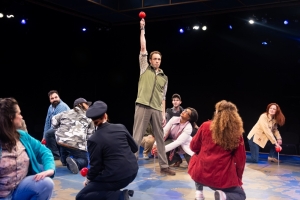
Come From Away begins from a place of deep uncertainty, yet what emerges is a story grounded in the steady, everyday kindness people offer when they have nothing else to give. Rather than revisiting the events of September 11 themselves, the musical focuses on the human responses that rose in their wake - small gestures that became anchors for thousands of strangers. Currently running at Marriott Theatre, this production leans into that humanity, reminding us that even in moments defined by fear, communities can reveal their best selves and set the stage for the remarkable true story that follows.
The origins of Come From Away trace back to the ten-year reunion of Gander residents and the airline passengers who found themselves unexpectedly grounded there during the September 11, 2001 airspace shutdown. Writers Irene Sankoff and David Hein attended that gathering, listening as people shared memories of fear, generosity, and the strange intimacy of those five days. Those first-hand accounts became the foundation of their musical, built from interviews, lived experiences, and the community’s own reflections.
Come From Away tells the remarkable true story of how the residents of Gander, Newfoundland opened their town to nearly 7,000 stranded passengers, transforming crisis into connection. Sankoff and Hein’s folk-infused score and ensemble-driven storytelling capture both the urgency of the moment and the warmth that defined the community’s response. Through intersecting vignettes - a pilot grappling with the weight of the tragedy, a couple who unexpectedly find love, and townspeople mobilizing with astonishing kindness as they scramble to meet the needs of thousands - the musical builds a fast-moving, emotionally resonant tapestry of resilience. The many moments are uniquely moving. One storyline follows a gay couple who initially fear they may have been displaced into a community that would not welcome them, only to discover that Gander’s embrace is far more open-hearted than they ever expected. Another centers on a mother whose son is a New York City firefighter, her fear deepening with every hour she goes without word of his safety. A further scene reveals how fear and uncertainty led to an instance of racial bias toward a Middle Eastern passenger, underscoring the tension and misunderstanding that shaped those early hours. It is also notable how long it took many of the stranded passengers to even learn why they had been grounded, completely unaware of the September 11 attacks unfolding beyond the airport tarmac.
One of the most striking things Come From Away made me realize is how little I had ever considered the logistics of suddenly hosting 7,000 unexpected guests. Lodging is the obvious hurdle, but the production makes you think about everything else: baby formula and diapers for stranded families, toothpaste and toilet paper for thousands of people who never planned to stay overnight, the sheer volume of food, toiletries, and basic supplies required to keep an entire town functioning under extraordinary circumstances. It is the kind of practical, human detail that rarely crosses your mind until a musical places it right in front of you. And right in the middle of all that panic and uncertainty, one passenger quietly quotes Philippians 4:6 — “Be anxious for nothing.” The moment lands with such gentle force that it clearly holds the audience, as if the reassurance reaches beyond the stage.
The ensemble works together with the fluid precision Come From Away is known for, but a few roles naturally carry more emotional weight. Beverly, played by Lexie Dorsett Sharp, provides one of the show’s strongest through lines, her reflections as a pilot adding quiet depth to the production. Claude, portrayed by Alex Goodrich, anchors the local perspective with a steady, good-humored presence as Gander’s mayor who so wonderfully inspires the townsfolk, while Hannah, brought to life by Sharriese Hamilton, is a deeply felt presence as the firefighter’s mother. Around them, the rest of the company contribute vivid moments that round out the tapestry of stories, each adding texture without overshadowing the show’s ensemble spirit.
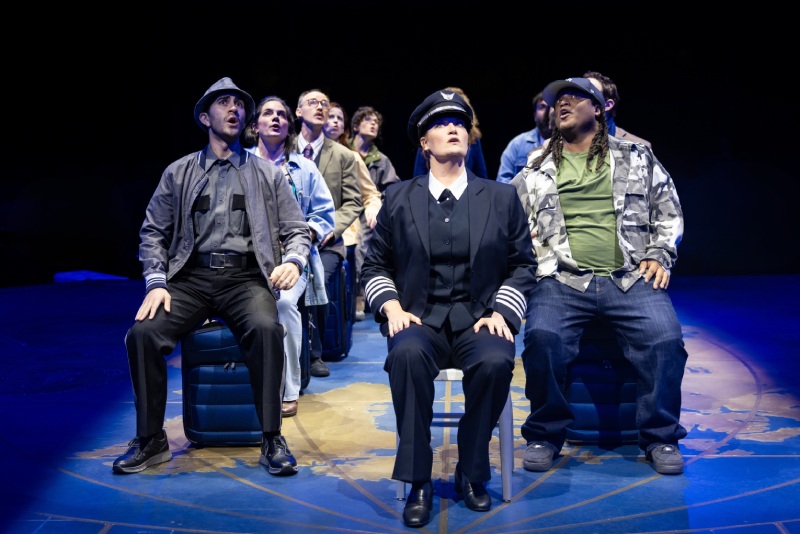
Lexie Dorsett Sharp and cast in Marriott's Come From Away. Photo by Justin Barbin.
The cast also gets a welcome lift from its other strong players, each actor shifting cleanly through multiple roles with the precision the show demands. Justin Albinder, in particular, delivers sharply timed, very funny moments that consistently land. Alongside him, Matt Crowle, Devin DeSantis, Denise Devlin, Sarah Bockel, Madison Kauffman, Heidi Kettenring, Michael Earvin Martin, and Jonathan Shaboo contribute to a unified, well-calibrated company whose collective work feels much larger than the sum of its parts.
Marriott’s production benefits from clear, confident leadership behind the scenes. Jessica Fisch’s direction keeps the ensemble moving with purpose, shaping the intersecting stories with a calm, assured touch that lets the emotional beats land without force. Katie Spelman’s choreography adds subtle lift to the staging - never flashy, but always intentional - helping the momentum build in ways that feel organic to the storytelling. Scenic designer Scott Penner and lighting designer Jesse Klug further elevate the production, using Marriott’s in‑the‑round configuration and luggage that doubles as plane seats to create the illusion of a bustling, overcrowded environment despite a cast of just twelve. Through razor‑sharp transitions, fluid movement, and smart spatial design, the stage often feels packed with 40 or 50 people, turning simplicity into spectacle without ever losing intimacy.
The musical’s score finds some of its strongest moments in a handful of standout numbers. “Me and the Sky,” led by Lexie Dorsett Sharp, remains the show’s defining emotional peak, her performance giving the song a grounded clarity that resonates long after it ends. Ensemble pieces like “Blankets and Bedding” and “28 Hours / Wherever We Are” showcase the cast’s cohesion, capturing both the frantic energy of Gander’s rapid mobilization and the passengers’ first fragile steps toward connection. Alex Goodrich brings an easy charm to “Screech In,” turning the raucous drinking ritual into one of the evening’s most crowd-pleasing scenes. And in “I Am Here,” Sharriese Hamilton delivers a quiet, concentrated punch, shaping one of the musical’s most affecting solo moments. The musical lift throughout is supported by conductor Celia Villacres and music coordinator Trevor Jones, whose work keeps the score driving, unified, and emotionally sharp. In these moments, the score shows its full range, moving easily between lightness, tension, and heartfelt storytelling.
What surprised me most was how deftly the musical balances somberness with humor. Given the weight of September 11th (now approaching its 25th anniversary), I expected the tone to stay anchored in grief, but Come From Away keeps finding pockets of levity, warmth, and genuine laughter. The humor never undercuts the tragedy; instead, it highlights the resilience and humanity that emerged in the midst of fear. The show moves back and forth between emotional registers with such ease that you are never left in one feeling for too long, making the experience unexpectedly uplifting.
Marriott Theatre’s production of Come From Away offers a thoughtfully crafted, emotionally grounded evening that earns its place among the company’s stronger musical offerings. The ensemble’s cohesion, the clarity of its overall arc, and the steady warmth woven throughout make this a production well worth seeing.
Highly Recommended.
Runs through October 18th at Marriott Theatre in Lincolnshire.
One hour and forty‑five minutes with no intermission.
Tickets and additional information: www.marriotttheatre.com/show/come-from-away
Nunsense, Not Quite Immaculate - But Blessed With a Strong Cast

Following its recent winter production of Sister Act, Drury Lane Theatre returns to the convent with Nunsense, a light-hearted musical comedy which, as the title implies, is a lot of nonsense.
The premise is funny, albeit morbid. After an unfortunate mishap, 52 members of the Little Sisters of Hoboken die from tainted soup prepared by Sister Julia, Child of God. With limited resources, the surviving nuns can only cover the funeral expenses of some of their sisters - leaving the remaining four bodies in their convent freezer, awaiting burial. How can they solve this problem? Well, stage a variety show, obviously! After all, while these women are nuns, they all wanted a moment in the spotlight.
E. Faye Butler, who also directed Sister Act, returns to stage Nunsense and injects the same optimism into this show. Unfortunately, it lacks the same substance, failing to elevate its premise beyond the initial idea.
The origin of Nunsense seems to explain its structural weakness. In the early 1980s, playwright Dan Goggin created a line of tongue-in-cheek greeting cards featuring a nun offering witty, irreverent quips. The cards were a hit, and Goggin used them as a jumping-off point for a cabaret show, which was later expanded into a full-length musical.
Unfortunately, the script doesn’t have much narrative depth or structural momentum. It seems to wander through quips and gags, trying to find a laugh rather than developing character or plot. At one point, we learn that a health inspector will fine them if they can’t raise the money by tomorrow, but it doesn’t land as a serious threat or even a driving force for the remainder of the show. The problem even has a quick resolution when Sister Mary Amnesia remembers her identity and discovers she’s suddenly rich thanks to a contest - talk about a deus ex machina (mary-ina, if you will).

Rachel Carreras in Drury Lane THeatre's Nunsense. Photos by Caitlin Dennis.
The book’s weaknesses are unfortunate because the cast is genuinely strong. Every member brings spectacular vocals to the stage, effortlessly belting out musical numbers and sounding excellent throughout.
Sharriese Hamilton delivers a standout performance as Sister Hubert. Her sassy comebacks and vocal riffs are hilarious, especially her trill in their rap. Her big second-act number, "Holier Than Thou," takes the audience to church and gives the show a much-needed jolt of energy. Cory Goodrich, Rachel Carreras, Kelly Felthous, and Aurora Boe also do well in their solo moments, whether it’s physical comedy, playing with a puppet, or ballet. Felthous gets to shine with her audience work and banter, and it is fun to see the cast do callbacks to specific interactions, such as flirting with or chiding audience members.
The show succeeds best when it moves quickly. Without much plot, gags can get tired easily. For instance, the Reverend Mother accidentally inhales a drug found in the girls’ locker room and goes to pieces. The sequence goes on a few beats too long. Transitions also could be tightened so the show doesn’t lose steam between numbers.
Nunsense is a fun idea, but the script fails to execute it satisfyingly. It’s also unclear who the intended audience is; the PG‑13 tone might make it a slightly tougher fit for families, even though they’d otherwise be a natural demographic.
While each performer gets a well-deserved moment to shine, it is a shame that such a talented cast doesn't have better material to serve either their collective skills or a meaningful story. Drury Lane's Nunsense has its moments, but it never quite reaches divine heights.
This review is proudly shared with our friends at www.TheatreInChicago.com.
Ron OJ Parson Directs a Masterful Revival of Ward’s 'Big White Fog'

Court Theatre has opened its 2025/26 season with a thunderclap: Theodore Ward’s Big White Fog directed with remarkable sensitivity and vigor by Resident Artist Ron OJ Parson. This is not only a revival of a classic work from the Federal Theatre Project era—it is also a reminder of how eerily contemporary Ward’s questions of ideology, disillusionment, and power struggles remain nearly ninety years after the play first startled audiences at Chicago’s Great Northern Theatre in 1938.
At its center, Big White Fog dramatizes the life of the Mason family, a striving Black household in Depression-era Chicago. Ward places the Mason living room at the intersection of history’s most turbulent crosscurrents: the false promise of the American Dream, the fiery appeal of Marcus Garvey’s “back to Africa” movement, and the revolutionary fervor of Communism. The fog of the title is both literal and metaphorical—a veil of economic despair, racial injustice, and ideological confusion that threatens to swallow the family whole.
Ron OJ Parson, long admired for his deft handling of Black classics, stages the play with clarity and urgency. Parson respects the density of Ward’s text but never lets the ideological debates bog down the human drama. Instead, he finds the beating heart in the Mason family’s conflicts—the stubborn pride of the patriarch, the sacrifices of the women, the fragile dreams of their children. Parson’s direction makes clear this is not an artifact of theatre history; it is a living work, pulsating with relevance for an America once again convulsed by inequality, polarization, and disillusionment.
The cast assembled for this production is outstanding. Joshua L. Green brings charisma and conviction to Victor Mason, the father whose fierce commitment to Garveyism and economic uplift sets him on a collision course with his family. Green embodies Victor’s unbending pride, making his devotion to a nationalist vision both inspiring and tragic. As Ella Mason, Sharriese Hamilton gives the play its moral core: her performance glows with quiet dignity, balancing love for her family with the weary pragmatism of a woman trying to hold a household together as history presses in from all sides.
Patrick Newson Jr. is superb as Lester Mason, the eldest son, a man who has had to stifle his own dreams, his every ambition weighed down by the crushing realities of family duty and economic hardship. Newson brings a heartbreaking openness to the role, embodying the innocence crushed under the weight of adult failures and historical forces. Greta Oglesby, as matriarch Martha Brooks, is simply unforgettable. Oglesby’s performance is steeped in humor, wisdom, and resilience; she grounds the play in generational memory. Her presence on stage is nothing short of magnetic.
The production’s design team gives Big White Fog a visual richness that matches its thematic weight. Jack Magaw’s scenic design transforms the Court stage into a lived-in Mason household, layered with details that evoke aspiration. Yvonne L. Miranda’s eye-popping 1920s costumes dazzle while grounding each character in their social and ideological context, making the clash of visions as visible as it is spoken. Lee Keenan’s lighting design shifts the mood with precision. Adding another layer of atmosphere, Christopher Kriz’s original compositions during scene changes, underscores the emotional undercurrents of the play and keeps the audience tethered to its restless rhythm.
The ideological clash within the Mason household is the play’s dramatic engine. Victor’s belief in Garvey’s call for Black economic independence and a return to Africa is met with resistance from his family, who seek other paths—through Communism, through assimilation, or through personal ambition. Ward refuses to let any single vision emerge as the sole solution, instead dramatizing the painful divisions that ideological fervor can create within a family. In the end, no ideology rescues them from the crushing realities of poverty, racism, and systemic neglect. This tragic irony is what makes Big White Fog so haunting.
Ward’s writing is radical for its time. To depict a Black family grappling openly with competing ideologies and the hypocrisy of the American Dream in 1938 was nothing short of revolutionary. It’s no wonder Big White Fog had a fraught reception in its original run. Yet the very qualities that unsettled audiences then—its candor, its ideological clashes, its refusal to reduce Black life to stereotype—are what make it feel so piercingly contemporary now.
The play’s questions echo loudly: What system, if any, can deliver justice and dignity to Black Americans? What price must be paid for loyalty to one’s ideals? And can a family survive when its members are torn apart by competing visions of liberation? In today’s America, as the nation debates racial justice, economic inequity, and the limits of free speech, these questions resonate with uncanny force. The Mason family’s divisions mirror our own: parents and children, neighbors and colleagues, citizens and leaders locked in ideological combat while the fog of inequality thickens around us.
Theodore Ward dared to write the truth. At a time when most mainstream depictions of Black life trafficked in stereotype or sentimental uplift (think “Cabin in The Sky”), Ward insisted on portraying the complexity, dignity, and contradictions of ordinary people. His plays carved out space for honest exploration of the Black experience—politically charged, socially grounded, unflinchingly real. Ward’s commitment cost him: his leftist sympathies drew the scrutiny of the FBI, and he was effectively blacklisted during the McCarthy era. Yet his legacy endures, shaping the lineage of Black theatre from Lorraine Hansberry to August Wilson and beyond.
Court Theatre’s revival is more than an act of cultural memory. It is an act of cultural urgency. To stage Big White Fog now is to recognize that the struggles Ward captured in 1938—the tensions between faith and politics, survival and principle, hope and despair—are still the struggles being faced in 2025. Parson and his cast honor Ward’s achievement while challenging us to confront the fog we still inhabit.
In the end, the play offers no easy answers. Ward was too honest for that. But what he gives us—through his words and through this luminous production—is the reminder that theatre can be a forum for grappling with the hardest questions of human existence. Big White Fog demands that we listen, that we argue, that we reckon with the past and the present alike.
Court Theatre has given Chicago audiences a gift in reviving Theodore Ward’s masterpiece. And with Parson’s masterful direction and this ensemble’s unforgettable performances, the fog clears just enough for us to see the truth: Ward’s voice still matters, perhaps now more than ever.
HIGHLY RECOMMENDED
When: Through Oct 11th
Where: Court Theatre, 5535 S. Ellis Ave.
Running !me: 2 hours, 15 minutes - 15 minute intermission
Tickets: $27 - $94 Student, Group and military discounts available
773-753-4472
*This review is also shared on https://www.theatreinchicago.com/!
United We Stand! Firebrand's "9 to 5 the Musical"

Many of us know the story. Three women who work in an office and seek revenge on an abusive male boss. Who can forget Dolly Parton, Lily Tomlin and Jane Fonda as they made a united stand for women in the now classic film “9 to 5”. Our women heroes are lovable, fiery and smart and, with that said, “9 to 5 the Musical” is playing at The Den Theatre and is a must see!
Recently, I have been on a Broadway kick and even bought season tickets and with a lackluster start of the season, I was ready to check out some local plays – something I encourage everyone to do. The Den Theatre is cozy, and the bar is nice as well. This wasn’t my first visit, but my first since they had renovated the space. With upgrades and newly created theatres, The Den is vastly improved and gives theatre goers even more reason to check out a play. The theatre is divided up in different sections across its three floors, each space unique from the other in order to hold different styles of plays.
The funny musical with music by Dolly Parton is put on by Firebrand Theatre which is all about empowering and employing women in the industry. With movements like “Time’s Up” and “Me Too,” it is great to hear about the work they are doing. “9 to 5” makes sense for Firebrand Theatre to produce as the story includes three strong women who are looking to bring in flexibility and positivity into the workplace.
The caliber of talent in this show speaks for itself. The production’s set, through simple, with the phenomenal voices belonging to each member of the diverse cast really stuck out in my mind. Sharriese Hamilton who played Doralee, was fantastic. Her energy and flawless southern accent was perfection. We see her character being followed by an office rumor of her having an affair with the manager, Mr. Hart. It was quite disgusting to see Mr. Hart, played by Scott Danielson, degrade her and do things around the office that put her in such compromising positions.
Violet (Anne Sheridan Smith) and Judy (Sara Reinecke) round out the trio. With excellent performances and growth throughout in each character, I couldn’t get enough of the show!
“9 to 5” reminds me of how far we have come but is also a reminder that we still have so much more to go when it comes to the workplace. We should continue with the fight and advocate for fairness in all aspects of life. We should do better.
Go see the musical that includes a variety of fun songs, including its title number, at the Den Theatre (1331 N. Milwaukee) as soon as possible. The play will be running until May 20th and tickets costs $45 and well worth the experience.
“9 to 5 the Musical” is being performed at Den Theatre in Wicker Park through May 20th. For more show info visit www.firebrandtheatre.org.
"All Shook Up" A Cheesily Fun Tribute to Elvis

Throughout the years, we have seen all kinds of homages to Elvis Presley whether it be Elvis impersonators, biographical films, Elvis night at U.S. Cellular Field and, of course, theatrical productions. Of these few tribute samples, some are serious and sensitive while others more tongue-in-cheek. “All Shook Up”, a musical using the music of Elvis, is definitely the latter. Now playing at Theatre at the Center in Munster, Indiana, “All Shook Up” is a story about an Elvis-alike roustabout who comes across a square town where the tightly-wound mayor has unjustly imparted laws against innocent activities such as kissing in public and dancing or the interracial mixing of partners. Though the plot line is as silly as it gets with unlikely, but still predictable love stories breaking out everywhere, it is hard not to be entertained by the music alone.
David Sajewich plays our hero Chad, the leather jacket clad bad-boy drifter with greased back hair who hops from town to town via his motorcycle with the purpose of challenging authority by infusing fun and excitement into boring and restricted communities. Sajewich is very funny in the role, ever so naturally delivering spot on physical comedy and one hilarious line after another. He also sings several Elvis classics with a good deal of enthusiasm, his vocals finding suitable range for each number despite not having the most powerful of voice. In the show’s opening number, “Jailhouse Rock” we quickly realize Sajewich will not be attempting to sound like Elvis Presley opting to use his own singing voice (writer or director’s choice?), leaving a small amount of disappointment for those who had hoped the story’s character so obviously designed around Elvis would kind of sound like him, if even in a comical way.
Like Abba’s music in Mamma Mia! or Green Day’s in American Idiot, the music of Elvis Presley is transformed into massive stage numbers with changing leads, large choruses and big time dance choreography. It was also refreshing to see such an obscure choice of Elvis Presley songs used for this production rather than only the obvious choices. “All Shook Up” included favorites like “Don’t Be Cruel”, “Love Me Tender”, Can’t Help Falling in Love”, "A Little Less Conversation” and “It’s Now or Never” but also added lesser known songs (at least outside the Elvis world) such as “Follow that Dream”, “C’mon Everybody”, “Devil in Disguise” and a heartfelt rendition of “If I Can Dream”.
Outside of the campy over-the-top story that is on the borderline of ridiculousness, despite its borrowed storylines from Shakespeare’s "Twelfth Night," "As You Like It" and "A Midsummer Night's Dream", “All Shook Up” includes several likeable characters that are fun to watch and listen to, especially Bethany Thomas (Sylvia) with her gutsy and very impressive singing voice. Callie Johnson also shows off her comic and singing ability as tomboy motorcycle mechanic Natalie Hallow who is crushing hard on Chad while Justin Brill as the geeky, love stricken Dennis is also enjoyable to watch. Matthias Austin gets some of the biggest laughs as Natalie’s square turned rocker father Jim, as deserved, but Sharriese Hamilton (Lorraine) might just have the best comic timing of the bunch.
Cheesy story and all, “All Shook Up” is a very entertaining show with great music, charm and lots of very funny moments. It’s always nice to see the music of Elvis passed on to new generations and this show is a perfect tool for doing so, as it is a production suitable for all ages alike.
The rock n’ roll hit Broadway musical “All Shook Up” is being performed at Theatre at the Center through August 16th Wednesdays through Sundays, including weekend matinees. For tickets and/or more show information, visit www.theatreatthecenter.com.




Latest Articles
-
 'The Snow Queen' presented by The Impostors Theatre Co. November 6th through November 21st
Written by Buzz Center StageAfter their award winning year, The Impostors Theatre Company (ITC) opens Season Eight with the highly anticipated world-premiere of The Snow Queen, a beloved folktale reimagined by ITC ensemble member Mallory Swisher, directed by ITC Artistic Director Stefan Roseen and…
'The Snow Queen' presented by The Impostors Theatre Co. November 6th through November 21st
Written by Buzz Center StageAfter their award winning year, The Impostors Theatre Company (ITC) opens Season Eight with the highly anticipated world-premiere of The Snow Queen, a beloved folktale reimagined by ITC ensemble member Mallory Swisher, directed by ITC Artistic Director Stefan Roseen and… -
City Lit announces August Wilson's KING HEDLEY II October 16 through November 29 - here the cast
Written by Buzz Center StageFull cast and production team have been announced for City Lit's production of August Wilson's KING HEDLEY II, to play from Friday, October 16 through Sunday, November 29. KING HEDLEY II is set in the same backyard in Pittsburgh's Hill…
-
 Standing Room Only Crowd for Chicago’s Leading Theater Artistic Directors
Written by Bill EslerIt must have been heavenly for the creative leaders of Goodman, Steppenwolf, Chicago Shakespeare and Court, Chicago’s top regional theaters, to be greeted by a standing room only crowd. But there they were, on a panel moderated by the eminent…
Standing Room Only Crowd for Chicago’s Leading Theater Artistic Directors
Written by Bill EslerIt must have been heavenly for the creative leaders of Goodman, Steppenwolf, Chicago Shakespeare and Court, Chicago’s top regional theaters, to be greeted by a standing room only crowd. But there they were, on a panel moderated by the eminent… -
 The Best of Us: Marriott Theatre’s Come From Away
Written by Kimberly KatzCome From Away begins from a place of deep uncertainty, yet what emerges is a story grounded in the steady, everyday kindness people offer when they have nothing else to give. Rather than revisiting the events of September 11 themselves,…
The Best of Us: Marriott Theatre’s Come From Away
Written by Kimberly KatzCome From Away begins from a place of deep uncertainty, yet what emerges is a story grounded in the steady, everyday kindness people offer when they have nothing else to give. Rather than revisiting the events of September 11 themselves,…
Does your theatre company want to connect with Buzz Center Stage or would you like to reach out and say "hello"? Message us through facebook or shoot us an email at This email address is being protected from spambots. You need JavaScript enabled to view it..
*This disclaimer informs readers that the views, thoughts, and opinions expressed in the text belong solely to the author, and not necessarily to Buzz Center Stage. Buzz Center Stage is a non-profit, volunteer-based platform that enables, and encourages, staff members to post their own honest thoughts on a particular production.