
Displaying items by tag: Tiffany Renee Johnson
Remy Bumppo’s Mud Row: A Family Haunted by the Past
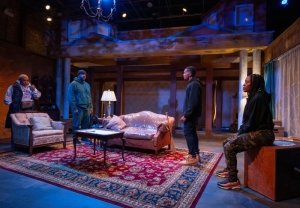
Remy Bumppo opens its 30th anniversary season with Mud Row, a play by Tony Award nominee and MacArthur “Genius” Grant recipient Dominique Morisseau. Expertly directed by Malkia Stampley, this production is a sublime examination of family, inheritance, and the difficult choices that determine what we pass on to the next generation.
Set in Mud Row, a historically Black neighborhood in West Chester, Pennsylvania, the play moves between the early 1960s, during the Civil Rights era, and the contemporary period. The earlier scenes follow sisters Elsie (Alexis Janae) and Frances (Toccara Castleman) as they navigate young adulthood, unaware that the decisions they make will reverberate through generations. In the present-day scenes, granddaughters, Regine (Ayanna Bria Bakari) and Toshi (Tiffany Renee Johnson), must confront the family legacy they have inherited.
Stampley has created a living family album, particularly in the scenes set in the 1960s. We watch Elsie and Frances move through their lives with the innocence of people who cannot yet see the long shadow their choices will cast. They are carrying wounds of their own, shaped by the circumstances in which they grew up. Without necessarily recognizing it, they risk passing that trauma to Elsie's unborn child and, eventually, to their grandchildren.
Morisseau's central question is both intimate and universal: What do we do with the past? Do we escape it, hoping that distance will free us from its burdens, or do we reclaim it, confront its painful truths, and find a way to transform what it means?
The family home becomes the physical embodiment of that question. Scenic designer Sydney Lynne creates a house that seems to possess a life of its own. In the 1960s scenes, it feels inhabited, furnished with the details of a home where people live, argue, dream, and make plans to change the future. In the contemporary scenes, the same space can appear abandoned, almost as if the house itself is yearning for someone to return and breathe life into it.
Yet even when the house is occupied, it never feels entirely free of its ghosts. Stampley makes those unseen presences palpable through breathtaking scene changes. The transitions are more than technical accomplishments; they reinforce the sense that the past is never entirely gone. It lingers in the rooms, in the silences, and in the relationships of those who remain.
The uniformly excellent cast gives Morisseau's dialogue its necessary emotional grounding. Her writing can, in less assured hands, occasionally sound like a discussion panel, with characters articulating ideas about history, race, and family rather than simply living through their circumstances. That is not the case here. These actors make the emotional intensity feel organic. Their conflicts emerge from recognizable human needs: the desire to belong, the longing to escape, the fear of repeating a parent's mistakes, and the hope that life might offer another chance.
Jabari Khaliq as Tyriek and Jamaque Thomas as Davin contribute to the ensemble, while the performances of Janae, Castleman, Johnson, and Bakari give the family history its emotional continuity. The younger women are not simply repeating the lives of those who came before them; they are struggling to determine what their inheritance means and whether they must remain bound by it. The emotional weight of that struggle comes into sharp focus in a second-act scene between Toshi and Regine that brought me to tears.
Levi Wilkins' lighting design deepens the atmosphere, while Evelyn Danner's costumes establish the distinct periods without distracting from the characters. Christopher Kriz's original musical composition and sound design help sustain the production's sense of memory, place, and time.
Morisseau examines two generations separated by decades but connected by patterns of family behavior, unspoken pain, and the consequences of choices made long before the next generation was born. The earlier generation belongs to the Silent Generation; the contemporary characters reflect a different set of expectations and possibilities. The contrast underscores how the world changes while certain family wounds remain stubbornly familiar.
But Mud Row is not simply a lament about the persistence of trauma. Its deeper concern is whether that inheritance can be interrupted. History may explain the circumstances in which people find themselves, but it does not have to dictate every choice they make. Somewhere in the cycle, a child—or an adult who finally recognizes the pattern—must be willing to say that things can be different.
That possibility gives the play its emotional force. The past cannot be erased, and neither can the damage it leaves behind. But understanding where the pain began may be the first step toward refusing to pass it along.
With this production, Remy Bumppo offers more than a beautifully staged family drama. Mud Row becomes a house of memories, inhabited by the living and haunted by the choices of the dead. Stampley's sensitive direction and the cast's compelling performances make those ghosts feel immediate, reminding us that every family inherits a history—but no family is necessarily doomed to repeat it.
HIGHLY RECOMMENDED
When: Through Nov. 15
Where: Theater Wit 1229 W. Belmont Avenue
Tickets: $38 - $54
"Braids, Dreams, and Resilience: JaJa’s African Hair Braiding Shines at Chicago Shakespeare Theater"

JaJa’s African Hair Braiding, written by first-generation Ghanaian American playwright Jocelyn Bioh and directed by Obie Award-winning Whitney White, is a vibrant celebration of the resilience, community, and complexity of West African immigrant women striving to establish their place in New York City. Currently receiving an acclaimed production at Chicago Shakespeare Theater, the play offers a poignant, colorful, and often humorous exploration of identity, survival, and aspiration in the face of challenges such as undocumented status, systemic inequities, and cultural displacement.
Set in a bustling Harlem hair braiding salon, the production immerses the audience in a world where conversations flow as freely as the braiding hands of skilled stylists. David Zinn’s set design meticulously recreates a Harlem salon, complete with brightly painted walls and posters of intricate braid designs. A steady stream of music fills the space, creating an environment that pulsates with life. Whitney White’s direction ensures every corner of this intimate setting remains vibrant with activity, embodying the controlled chaos where clients, stylists, and commerce intersect.
Bioh’s talent for crafting razor-sharp dialogue between women is fully realized here—no surprise from the playwright behind School Girls; or, the African Mean Girls Play. She skillfully weaves together a rich tapestry of personalities and cultural backgrounds, resulting in an ensemble that crackles with authenticity and charm.
At the heart of the story is JaJa, portrayed with commanding presence by Victoire Charles, and her daughter Marie, played with youthful vigor by Jordan Rice. Both Senegalese women have aspirations that stretch beyond their circumstances. Aisha Sougou’s Ndidi, a Nigerian with an encyclopedic knowledge of the soap operas playing in the salon, serves as a comedic anchor. Meanwhile, Awa Sal Secka’s Bea, a proud Ghanaian and longtime employee, offers a compelling foil to Ndidi’s antics, resisting with simmering resentment but asserting herself as the true Queen Bee when necessary. Tiffany Renee Johnson, last seen in Blues for An Alabama Sky, delivers a standout performance as Aminata, Bea’s devoted gossip partner, now preoccupied with her own troubles.
Bisserat Tseggai infuses Miriam, a Sierra Leonean longing for lost love, with a tender wistfulness, while Mia Ellis’s Jennifer spends the entire day getting her hair done and dispensing advice. Special mention must be made of the chameleon-like talents of Melanie Brezill, a standout in Stokley: The Unfinished Revolution, and Leovina Charles, who nimbly juggles six different customer roles between them, injecting each with distinct personality. Yao Dogbe, whom I last saw in Intimate Apparel, is the lone male in the cast and effortlessly steps into various roles with charm and versatility.
Illegal immigration is a central theme in JaJa’s African Hair Braiding, and Bioh handles it with nuance and compassion. The fear of deportation and the pressures of living in the shadows are palpable, yet these issues are presented with sensitivity, avoiding one-dimensional portrayals. Instead, the play highlights the characters' individuality, dreams, and relationships, reminding the audience of the humanity behind the headlines.
The artistry of Hair and Wig Designer Nikiya Mathis truly steals the spotlight in this production. As the first wig designer to receive a special Tony Award for her groundbreaking work on the Broadway production, Mathis brings her award-winning expertise to Chicago Shakespeare Theater with stunning results. Each intricate braid and carefully styled wig not only enhance the authenticity of the characters but also serves as a visual testament to the cultural richness at the heart of the story. Complementing Mathis’s work is Costume Designer Dede Ayite, whose keen eye for detail and vibrant selections beautifully capture the essence of each character, reflecting their personalities and cultural heritage with remarkable precision. Together, Mathis and Ayite create a visually immersive experience that elevates the production to new heights.
JaJa’s African Hair Braiding is a testament to the power of storytelling in illuminating the lives of those often overlooked. Through its richly drawn characters, sharp writing, and dynamic direction, the play captures the essence of a community striving against the odds, celebrating their culture while forging paths toward a better future. It’s a timely, heartfelt production that leaves audiences not only entertained but also more empathetic and informed about the realities faced by so many immigrants in America and today, don’t we need more empathy
Highly Recommended
When: Through Feb. 2
Where: Chicago Shakespeare Theatre 800 East Grand Avenue in Chicago.
Tickets: $30 - $90
Info: www.chicagoshakespeare.com
Review: 'A Doll's House' at Writers Theatre

Is love a commodity? Ibsen’s enduring drama “A Doll’s House” has asked audiences for over a century. Writers Theatre unveils a new 90 minute pared-down adaptation penned by Sandra Delgado and directed by Lavina Jadhwani.
“A Doll’s House” is one of Ibsen’s most known plays. It tells the story of a society woman, Nora (Cher Alvarez) and her struggles with money. Her husband Torvald (Greg Matthew Anderson) patronizes her like she’s one of the children, as long as she plays the happy wife. All seems joyful until a childhood friend, Christine (Tiffany Renee Johnson), comes to ask a favor. Nora, though docile, has her own secrets and when a debt comes due, she must act in order to protect her husband’s reputation.
Ibsen and Chekhov make some theatre-goers groan. Classic theatre can often be a long evening, but Delgado takes the lengthy work and shortens it down to a one-act without intermission. Her script begs the question, is that necessary? Translations can make all the difference in how we perceive classic works of literature. One translation can vastly differ from another and their authors are usually long dead. It’s hard to say if their intentions translate. In the case of Writer’s adaption of “A Doll’s House” it somewhat misses the mark.
Performances are good, but they overshadow a wooden script. There’s a degree of inconsistency from line to line. Some dialogue is perfectly modern while other parts seem like a more literal word for word translation that leaves out most of the passion. Unfortunately streamlining this script for a 90-minute run time edited out the poetry, or any memorable strands of dialogue for that matter. This production feels more like a SparkNotes summary of the original rather than an adaptation.
Cher Alvarez’s Nora is the heart and soul of this production. She breathes life into the clunky dialogue and by the end she’s the only character to elicit much emotional response from the audience. Her performance serves as the depth that’s missing from Delgado’s script. Greg Matthew Anderson as the doting husband Torvald, adds dimension to the character who is otherwise pretty flat. Which is just the issue here, it’s as if the playwright wrote caricatures of Ibsen characters in order to shift the focus toward a grander point about loveless marriages. That point never really solidifies and it’s up to the audience to decide what Ibsen’s intentions were.
There’s been a renewed interest in this classic as Lucas Hnath’s Broadway smash hit “A Doll’s House Part 2” (2017) is one of the most produced plays in America right now. And there’s good reason, it’s a great modern take on the themes originally explored by Ibsen. There’s an edge to his sort of sequel. There’s no edge in this current production at Writers Theatre. For Ibsen purists, this production will be disappointing but those with a tepid interest will be rewarded by the short run time and outstanding performances.
Through December 15 at Writers Theatre - 321 Tudor Court, Glencoe. 847-242-6000




Latest Articles
-
 Music Theater Works Pours a Beachy Cocktail with Escape to Margaritaville
Written by Kimberly KatzA gentle, tide‑easy current settles in right from the start, immediately signaling the kind of story this musical wants to tell. Rather than relying on big, splashy moments, it settles into a warm, beach-side rhythm, inviting the audience into a…
-
 Chicago Shakespeare Makes Winter’s Tale a Story Worth Telling
Written by Angelo CamposChicago Shakespeare Theater’s production of The Winter’s Tale delivers a compelling evening of theater, showcasing an exceptional company of actors working at the top of their craft. Under the direction of Artistic Director Edward Hall, this staging marks an exciting…
-
 A Joe & Melanie Thing Theatre Company announces The Hanukkah Humbug at Greenhouse Theater Center - December 3-6
Written by Buzz Center StageThe world premiere of The Hanukkah Humbug brings ghosts, history, tradition, and a whole lot of family fun to the Greenhouse Theater Center just in time for the holidays, Melanie Ann Apel promises a lively, family-friendly experience with this new…
-
 Remy Bumppo’s Mud Row: A Family Haunted by the Past
Written by Wesley DavidRemy Bumppo opens its 30th anniversary season with Mud Row, a play by Tony Award nominee and MacArthur “Genius” Grant recipient Dominique Morisseau. Expertly directed by Malkia Stampley, this production is a sublime examination of family, inheritance, and the difficult…


Does your theatre company want to connect with Buzz Center Stage or would you like to reach out and say "hello"? Message us through facebook or shoot us an email at This email address is being protected from spambots. You need JavaScript enabled to view it..
*This disclaimer informs readers that the views, thoughts, and opinions expressed in the text belong solely to the author, and not necessarily to Buzz Center Stage. Buzz Center Stage is a non-profit, volunteer-based platform that enables, and encourages, staff members to post their own honest thoughts on a particular production.