
Displaying items by tag: Mud Row
Remy Bumppo’s Mud Row: A Family Haunted by the Past
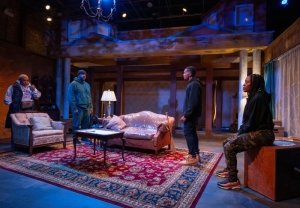
Remy Bumppo opens its 30th anniversary season with Mud Row, a play by Tony Award nominee and MacArthur “Genius” Grant recipient Dominique Morisseau. Expertly directed by Malkia Stampley, this production is a sublime examination of family, inheritance, and the difficult choices that determine what we pass on to the next generation.
Set in Mud Row, a historically Black neighborhood in West Chester, Pennsylvania, the play moves between the early 1960s, during the Civil Rights era, and the contemporary period. The earlier scenes follow sisters Elsie (Alexis Janae) and Frances (Toccara Castleman) as they navigate young adulthood, unaware that the decisions they make will reverberate through generations. In the present-day scenes, granddaughters, Regine (Ayanna Bria Bakari) and Toshi (Tiffany Renee Johnson), must confront the family legacy they have inherited.
Stampley has created a living family album, particularly in the scenes set in the 1960s. We watch Elsie and Frances move through their lives with the innocence of people who cannot yet see the long shadow their choices will cast. They are carrying wounds of their own, shaped by the circumstances in which they grew up. Without necessarily recognizing it, they risk passing that trauma to Elsie's unborn child and, eventually, to their grandchildren.
Morisseau's central question is both intimate and universal: What do we do with the past? Do we escape it, hoping that distance will free us from its burdens, or do we reclaim it, confront its painful truths, and find a way to transform what it means?
The family home becomes the physical embodiment of that question. Scenic designer Sydney Lynne creates a house that seems to possess a life of its own. In the 1960s scenes, it feels inhabited, furnished with the details of a home where people live, argue, dream, and make plans to change the future. In the contemporary scenes, the same space can appear abandoned, almost as if the house itself is yearning for someone to return and breathe life into it.
Yet even when the house is occupied, it never feels entirely free of its ghosts. Stampley makes those unseen presences palpable through breathtaking scene changes. The transitions are more than technical accomplishments; they reinforce the sense that the past is never entirely gone. It lingers in the rooms, in the silences, and in the relationships of those who remain.
The uniformly excellent cast gives Morisseau's dialogue its necessary emotional grounding. Her writing can, in less assured hands, occasionally sound like a discussion panel, with characters articulating ideas about history, race, and family rather than simply living through their circumstances. That is not the case here. These actors make the emotional intensity feel organic. Their conflicts emerge from recognizable human needs: the desire to belong, the longing to escape, the fear of repeating a parent's mistakes, and the hope that life might offer another chance.
Jabari Khaliq as Tyriek and Jamaque Thomas as Davin contribute to the ensemble, while the performances of Janae, Castleman, Johnson, and Bakari give the family history its emotional continuity. The younger women are not simply repeating the lives of those who came before them; they are struggling to determine what their inheritance means and whether they must remain bound by it. The emotional weight of that struggle comes into sharp focus in a second-act scene between Toshi and Regine that brought me to tears.
Levi Wilkins' lighting design deepens the atmosphere, while Evelyn Danner's costumes establish the distinct periods without distracting from the characters. Christopher Kriz's original musical composition and sound design help sustain the production's sense of memory, place, and time.
Morisseau examines two generations separated by decades but connected by patterns of family behavior, unspoken pain, and the consequences of choices made long before the next generation was born. The earlier generation belongs to the Silent Generation; the contemporary characters reflect a different set of expectations and possibilities. The contrast underscores how the world changes while certain family wounds remain stubbornly familiar.
But Mud Row is not simply a lament about the persistence of trauma. Its deeper concern is whether that inheritance can be interrupted. History may explain the circumstances in which people find themselves, but it does not have to dictate every choice they make. Somewhere in the cycle, a child—or an adult who finally recognizes the pattern—must be willing to say that things can be different.
That possibility gives the play its emotional force. The past cannot be erased, and neither can the damage it leaves behind. But understanding where the pain began may be the first step toward refusing to pass it along.
With this production, Remy Bumppo offers more than a beautifully staged family drama. Mud Row becomes a house of memories, inhabited by the living and haunted by the choices of the dead. Stampley's sensitive direction and the cast's compelling performances make those ghosts feel immediate, reminding us that every family inherits a history—but no family is necessarily doomed to repeat it.
HIGHLY RECOMMENDED
When: Through Nov. 15
Where: Theater Wit 1229 W. Belmont Avenue
Tickets: $38 - $54



Latest Articles
-
 A Joe & Melanie Thing Theatre Company announces The Hanukkah Humbug at Greenhouse Theater Center - December 3-6
Written by Buzz Center StageThe world premiere of The Hanukkah Humbug brings ghosts, history, tradition, and a whole lot of family fun to the Greenhouse Theater Center just in time for the holidays, Melanie Ann Apel promises a lively, family-friendly experience with this new…
-
 Remy Bumppo’s Mud Row: A Family Haunted by the Past
Written by Wesley DavidRemy Bumppo opens its 30th anniversary season with Mud Row, a play by Tony Award nominee and MacArthur “Genius” Grant recipient Dominique Morisseau. Expertly directed by Malkia Stampley, this production is a sublime examination of family, inheritance, and the difficult…
-
Identity Performing Arts' Fifth Anniversary Gala: Movement That Keeps Becoming
Written by Wesley DavidFive years is an important milestone for any arts organization, but for a contemporary dance company it also marks an artistic coming of age. Identity Performing Arts celebrated its fifth anniversary at the Edlis Neeson Theater at the Museum of…
-
Overshadowed Theatrical Productions Brings Beloved Holiday Classic It’s a Wonderful Life to the Stage
Written by Buzz Center StageThis holiday season, Overshadowed Theatrical Productions is thrilled to present the timeless holiday classic, It’s a Wonderful Life, live on stage. As Frank Capra’s legendary film celebrates its 80th anniversary, this stage adaptation offers the perfect way for families and…
Does your theatre company want to connect with Buzz Center Stage or would you like to reach out and say "hello"? Message us through facebook or shoot us an email at This email address is being protected from spambots. You need JavaScript enabled to view it..
*This disclaimer informs readers that the views, thoughts, and opinions expressed in the text belong solely to the author, and not necessarily to Buzz Center Stage. Buzz Center Stage is a non-profit, volunteer-based platform that enables, and encourages, staff members to post their own honest thoughts on a particular production.